Engineers publish first global manual for structural bamboo design
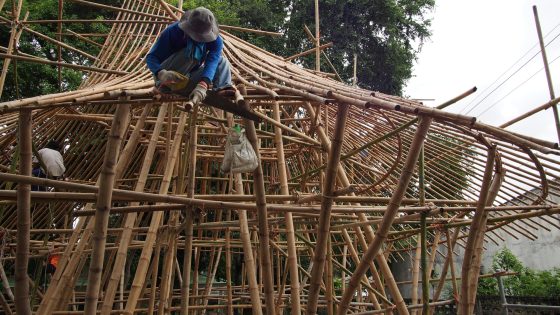
An international team led by engineers at the University of Warwick has produced what is described as the world’s first structural engineering manual for bamboo.
The freely available guide is intended to help widen the use of the plant as a low‑carbon construction material.
Bamboo has a long history as a building material in many parts of the world but was largely sidelined in the 20th century as industrial materials such as steel and concrete became dominant and national building codes developed without provisions for bamboo. The new manual, published by the Institution of Structural Engineers (IStructE), aims to fill that gap by offering design guidance for the use of bamboo poles as primary structural elements and for a system known as Composite Bamboo Shear Walls (CBSW), which is promoted as suitable for housing in earthquake‑ and typhoon‑prone regions.
The project was produced through collaboration between the University of Warwick, the University of Pittsburgh, engineering firm Arup, the International Network for Bamboo and Rattan (INBAR) and the Bamboo and Rattan Information and Development (BASE) group.
Contributors say the manual covers strength, durability and safety issues – including fire provisions – and is intended for engineers, architects and researchers across the tropics and subtropics where bamboo grows naturally.
“Bamboo is a fast‑growing, strong, inexpensive and highly sustainable material,” said Dr David Trujillo, assistant professor in humanitarian engineering, School of Engineering, Warwick University, summarising the case for renewed interest. He added that countries which historically developed formal construction codes had not prioritised bamboo, creating a need for international collaboration.
Kent Harries, professor of structural engineering and mechanics, University of Pittsburgh, said bamboo’s mechanical properties and low‑carbon credentials make it a promising bio‑based resource, but stressed that safe, durable design is essential. The manual is intended to provide that technical foundation.
The guide focuses principally on the use of bamboo poles as beams and columns, and on CBSW systems, which the authors suggest can deliver resilient housing in regions exposed to seismic and cyclonic hazards. With more than 1,600 species of bamboo distributed across all continents except Antarctica, the authors argue the manual could expand practical use of the material, particularly since it will be made available at no cost.
The manual explicitly addresses fire safety as part of its provisions for permanent buildings, rather than temporary works such as scaffolding. In a statement included with the launch, the Warwick team referred to recent fatal tower block fires in Hong Kong and said general risk‑management practices point to the need for fire‑retardant materials, detection and suppression systems on high‑rise or closely spaced buildings, while noting they were awaiting investigation outcomes before drawing specific conclusions.
The manual’s publication comes amid growing interest in low‑carbon building methods as governments and industry seek to reduce emissions associated with cement and steel production. Whether bamboo can scale up to make a significant contribution will depend on supply chains, treatment technologies to prevent decay and insect attack, training of designers and craftsmen, and regulatory acceptance in different countries.
A free PDF copy of the manual is available here.
In 2024, NCE spoke to researchers at the University of East London about using sugarcane refinement by-product bagasse as the basis for construction units called Sugarcrete.
Like what you’ve read? To receive New Civil Engineer’s daily and weekly newsletters click here.
link