Experimental evaluation of the effect of openings on the structural performance of diagonally reinforced coupling beams
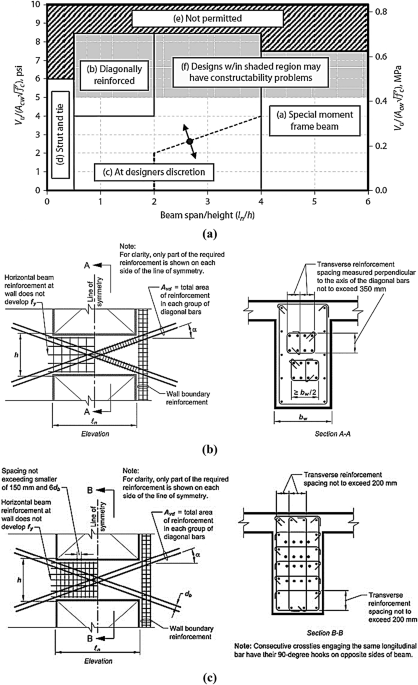
Although many researchers have investigated the behavior of coupling beams, few have examined those with openings. Additionally, there are no specific recommendations in codes regarding the behavior of coupling beams that contain openings. Therefore, this study aims to provide insights into the behavior of coupling beams with openings; and to identify the appropriate conditions for using openings in coupling beams. Thus, the study experimentally investigates the behavior of coupling beams with openings. It focuses on the effects of openings on important behavior parameters such as crack pattern and propagation, yield and ultimate strength, ductility, stiffness degradation, and energy dissipation. These parameters are compared to those of the corresponding solid beam. For one sample, intersecting diagonal bars around the opening and short stirrups above and below the opening, as recommended by Mansur (2006)27, were provided as an attempt to reduce stress concentration in the opening area and prevent premature cracking and failure.
Experimental program
Three short half-scale coupling beams were prepared and tested in this study: two with openings (E-Op and E-Op-Ad) and one without (S), which served as the reference. The labels for the beams are as follows: ” E-Op” refers to an opening near the span end and “Ad” refers to additional reinforcement. All specimens were designed to have a shear stress (q) equal to 0.48 \(\sqrt {{{f^{\prime}}_c}}\) (MPa), where q is calculated as the shear strength of a coupling beam divided by its cross-sectional area (b × h). The shear strength (q) of the coupling beams was calculated according to Sect. 18.10.7.4 of ACI 318 − 191.
All specimens had the same dimensions: 400 mm for both depth and length (span-to-depth ratio, l/h = 1), and 150 mm for the width. The reinforcement details were constant for all specimens, featuring two diagonally reinforced cages with confinement stirrups around the interior beam cross-section, as permitted by the second option of the ACI 3181. The diagonal bars used were 4Ø10 for each group, with an inclination angle (α = 35°). Longitudinal bars were 3Ø12 at the top and bottom, with intermediate bars of 2Ø10 every 110 mm, and vertical stirrups of Ø8 every 70 mm, computed according to ACI recommendations1. The E-Op-Ad specimen differs by the addition of short stirrups and additional diagonal reinforcement above and below the opening. The opening located near the beam end (at distance of 30 mm from the fixed support). The opening dimensions were the same for the specimens with openings: 55 mm in width and 95 mm in height (lo/l = 0.14 and ho/t = 0.24). Specimens’ details, including opening locations, are summarized in Table 1. Besides, Figs. 3 and 4 show photos during specimen preparation with full beam layout and reinforcement details.

Preparing of specimens; (a) RFT cages; (b) ready for casting; and (c) after casting.

Geometry and details of RFT for specimens: (a) Specimen (S); (b) Specimen (E-Op); and (c) specimen (E-Op-Ad).
Material properties
A concrete mixture with a target compressive strength of 30 MPa was designed for coupling beams and blocks. Ordinary Portland cement Type 42.5 N was used, and the average water-cement ratio (w/c) was 0.50. Three cubes were prepared and tested at 28 days. The resulting cubic compressive strength ranged from 29 to 35 MPa, which was considered acceptable compared to the target design strength of 30 MPa. The ultimate compressive strengths for the specimens are listed in Table 2. Tensile tests were conducted on reinforcing (RFT) bars, and the resulting stress-strain curves are presented in Fig. 5. The bars have an elastic modulus of 200,000 MPa and a Poisson’s ratio of 0.3. The average yield strengths were 350 MPa (D10 bars) and 380 MPa (D12 bars), and the average ultimate strengths were 484 MPa (D10 bars) and 510 MPa (D12 bars).

Stress-strain curve of steel reinforcing bars; (a) D10, and (b) D12.
Test setup
Two stiff blocks were used at the ends of coupling beams to simulate the surrounding walls; they also served in applying the load. The specimens were tested vertically; the lower block was restrained from movement using high-grade threaded rods and side constraints. The upper block was connected to a rigid steel system consisting of two I-beams (HEA300) with added web stiffeners and two 15 mm thick steel plates (one on each side of the upper block). The entire system (coupling beam, steel plates, and I-beams) was interconnected by high-grade threaded rods passing through pipes embedded in the upper block’s cross-section. The rigid steel system was designed to transfer the load along a line of action passing through the mid-span of the coupling beam, ensuring zero moment. The number and diameter of the high-grade threaded rods were designed to prevent buckling failure and ensure that all parts acted as a single rigid system. The rigid steel system was designed to transfer the entire load to the coupled wall system without any local deformation in the I-beams. The upper support acted as a free end condition without any restraints. Figure 6 illustrates the test setup and the position of each component.
Methodology and instrumentation
All specimens were subjected to the same quasi-static loading protocol to simulate the near-collapse mechanism of coupling beams in coupled shear wall systems subjected to earthquake forces. For each chord rotation amplitude, two consecutive loading cycles were applied to monitor the degradation in the coupling beam’s strength and stiffness. Force-controlled analysis was employed in this study despite the advantages of displacement-controlled loading for post-yield characterization, as the necessary equipment was unavailable. A constant loading rate of 15 kN/min was applied. To mitigate inertial effects, the load and deformation were closely monitored using strain gauges, displacement transducers, and load cells, enabling real-time adjustments to the loading rate to maintain quasi-static conditions. The load cycles increased gradually in 25 kN increments until significant crack widening indicated the onset of collapse and large displacements were recorded. The force was then gradually reduced to 0.80 of the ultimate force. The loading history is illustrated in Fig. 7. However, this type of loading differs from actual seismic response, which involves unsymmetrical loading and a fewer number of cycles.
Based on the expected deformation of the coupling beams, see Fig. 8, two linear variable differential transducers (LVDTs) were installed at the right and left sides of the upper end of the beam to measure the positive and negative lateral displacements (Δh). Since the upper block was unrestrained against rotation, one LVDT was used to calculate the vertical displacement (Δv). Thus, the chord rotations at the bottom and top ends (θb and θt) of the beam can be calculated as follows:
$${\theta _B}={\Delta _h}/{\text{ }}l$$
(2)
$${\theta _T}=\alpha \,+\,{\Delta _h}/{\text{ }}l$$
(3)
where:
$$\alpha ={\Delta _v}/{\text{ }}(h/2)$$
(4)
where; l and h are the beam length and height, respectively. Thus; the average chord rotation (θAvg) can be computed as:
$${\theta _{Avg}}=({\theta _B}\,+\,{\theta _T})/2$$
(5)
$${\theta _{Avg}}={\text{ }}({\Delta _h}/{\text{ }}l\,+\,\alpha \,+\,{\Delta _h}/{\text{ }}l)/2\,=\,{\Delta _h}/{\text{ }}l\,+\,\alpha /2$$
(6)
The load cell was moved manually during testing. So, additional LVDT was used to monitor the out-of-plane movement during testing to ensure that the load cell acting along the line of action passing through the center of out-of-plane direction of the beam. The out-of-plane movement was excluded in the calculations of chord rotations of the coupling beam.
To better understand the behavior of the specimens during testing, five strain gauges were installed in each specimen to measure strains at critical sections of the reinforcement bars. Four critical sections were chosen based on previous literature: two on the diagonal bars at the intersection of the two diagonal groups (at the beam mid-span) and two at the beam ends (adjacent to the fixed block). The fifth strain gauge was installed on the vertical stirrups adjacent to the opening, in the region expected to experience high shear stress concentration. For specimen E-Op-Ad, two additional strain gauges were added at the beam ends to measure the strain in the added diagonal bars and short stirrups. The locations of the strain gauges are shown in Fig. 9. The measured strain histories in the specimens were recorded and are presented in the Appendix A.


LVDT setup location and chord rotation measurement.

Strain gauges’ installation and locations: (a) Specimen (S); (b) Specimen (E-Op); and (c) specimen (E-Op-Ad).
Test results and discussions
The test results of the specimens, including crack propagation, failure modes, cracking loads, shear capacity, and cyclic curves (representing the relationship between chord rotation (θ) and shear force (V)), were extracted and discussed to compare the behavior of solid coupling beams with those containing openings.
Initiation of cracks and cracking load
The initiation, location, shape of cracks, and type of failure were observed and discussed. For solid coupling beam, the first crack appeared near the mid-height of the beam at a load of Pcr= 75 kN. This crack was followed by small diagonal cracks, these cracks grew very slowly and spread diagonally across the beam. At higher loading rates, these cracks grew significantly, increasing in both height and depth as the applied load increased. For the other two coupling beams with openings, the first crack initiated diagonally at the external top corner of the opening, immediately followed by small cracks at the beam end and small diagonal cracks originating from the opening’s ends and extending through the beam ends. Cracks at the corners of the opening increased and grew as the applied load increased. Figure 10 from a to c illustrates the pattern and propagation of cracks at different stages of loading during testing for the three specimens. The presence of openings decreased the cracking loads (Pcr) to 25 kN and 40 kN for specimens E-Op and E-Op-Ad, respectively, representing reductions of 66.67% and 46.67% compared to the solid beam (S).

Pattern and propagation of cracks at different rate of loading for: (a) Specimen (S); (b) Specimen (E-Op); and (c) specimen (E-Op-Ad).
Shear-rotation responses
The relationship between shear force (V) and rotation (θ) reveals the key characteristics of the seismic behavior of coupling beams, such as shear capacity, ductility, and stiffness degradation. Cyclic curves for all specimens are presented in Fig. 11 (a to c). The main parameters (Vy, Vu, Vf, θy, θu, θf, and Ky), which represent the yield shear force, ultimate capacity, failure load, yield rotation, ultimate chord rotation, chord rotation at failure, and stiffness at the yield point, respectively, were extracted from the envelope curve, as illustrated in Fig. 12 and listed in Table 3. The yield point was determined according to28 as the intersection of a horizontal line representing the ultimate load and a straight line extending from the origin through a point representing 3/4 of the ultimate capacity. Vu is the peak strength (ultimate load), and Vf is defined as the point at which the strength has reduced by 20% of the ultimate value, Vu. θy, θu, and θf represent the rotations at the yield point, ultimate load, and failure load, respectively.

Cyclic curves of tested specimens: (a) (S); (b) (E-Op); and (c) (E-Op-Ad).

Main characteristics of the envelop curve.
Shear capacity and progress of damage and failure
During testing, the evolution of damage was observed to investigate the behavior of different specimens at the final stage until failure. For the solid coupling beam (S), damage occurred as a result of the widening of two major diagonal cracks, which increased significantly as the loading rate increased. Simultaneously, a large, widening crack increased significantly at the end side of the beam. Failure ultimately occurred due to buckling of the diagonal bars and crushing of concrete in the diagonal direction of the coupling beam, accompanied by separation damage between the beam and the fixed block. In the case of the coupling beam with an end opening (E-Op), very extensive cracks spread along the entire length of the beam, especially around the opening, accompanied by a very wide crack at the beam end, which increased significantly as the loading rate increased, causing separation between the beam and the fixed block. Adding reinforcement around the opening in specimen (E-Op-Ad) effectively controlled the cracks around the opening. The cracking pattern was similar to that of the solid one, with two major diagonal cracks that increased significantly as the loading rate increased. However, at high loading rates (high rotations), the crack at the edge of the beam increased sharply, and the beam finally failed due to separation between the beam and the fixed block. This damage was accompanied by significant damage in the diagonal directions of the beam as a result of the widening of the two major diagonal cracks. Figure 13 (a to c) displays the deterioration and damage at the failure stage for the different specimens.
Based on the results in Table 3, a comparison was made in Fig. 14 between the solid coupling beam and the corresponding beams with openings. The results indicate that introducing an opening at the end of the coupling beam near the fixed block, specimen (E-Op), caused a reduction in the yield and ultimate shear forces of 11.97% and 16.25%, respectively. This effect decreased to 7.78% and 7.49% when intersecting diagonal bars and short stirrups were added around the opening in specimen (E-Op-Ad), which successfully mitigated the effect of the opening by decreasing the stress concentration around the opening. On the other hand, all the three specimens achieved maximum strength exceeded the shear capacity formula recommended by ACI1. In case of the standard beam (S) the maximum strength was higher than ACI’s formula by about 64%. However, for the other beams with openings (E-Op and E-Op-Ad) the increase reduced to 37.3% and 51.3%, respectively.

Damage of coupling beams, (i) Pattern of cracks at failure stage and (ii) mode of failure for specimens: (a) S, (b) E-Op, and (c) E-Op-Ad.

Yield and ultimate loads comparison between the tested specimens.
Ductility
Ductility, the ability of a member to undergo large deformations before failure, is considered one of the most important characteristics for evaluating the suitability of coupling beams in resisting seismic loads in coupled shear wall systems. The ductility index (µ) is the most widely used method for quantifying ductility and can be calculated according to28 using the following equation:
$${{\mu }}={\theta _f}/{\theta _y}$$
(7)
where θy and θf are the yielding and maximum chord rotations, respectively, as described previously in Fig. 12. Table 3 lists the yield and maximum chord rotations for the different specimens. The solid coupling beam exhibited ductile behavior with µ = 2.02, achieving 1.96% and 3.96% for the yield rotation (θy) and maximum chord rotation (θf), respectively. The presence of the opening in specimen (E-Op) negatively impacted ductility, reducing µ, θy, and θf to 1.61, 1.85%, and 2.98%, respectively. The reinforced coupling beam (E-Op-Ad) effectively controlled cracking and reduced stress concentration at the opening edges, resulting in improved performance compared to E-Op and exhibiting behavior similar to the solid beam (S), with slight decreases in µ, θy, and θf to 1.99, 1.93%, and 3.85%, respectively.
Stiffness degradation and yield stiffness
Analysis of stiffness reduction for reinforced concrete (RC) members subjected to cyclic loading is widely used to express damage deterioration and determine the suitability of members for resisting seismic loads. Members exhibiting sudden and high-rate stiffness reduction at low rotation percentages should be avoided in systems subjected to severe seismic loads and replaced with members exhibiting gradual and low stiffness reduction coupled with high ductility. Stiffness degradation can be extracted from the relationship between secant stiffness (K) and rotation (θ), where K is the secant stiffness at the amplitude of each half-cycle. Stiffness degradation for the different specimens was extracted and plotted in Fig. 15. The specimens (S) and (E-Op-Ad) exhibited gradual and low stiffness reduction compared to specimen (E-Op), which showed a significant reduction in stiffness as the rotation increased. Adding reinforcement detailing around the opening in specimen (E-Op-Ad) successfully improved the stiffness of the coupling beam and even surpassed that of the corresponding solid one at small rotations. However, it failed to control stiffness deterioration at large deformations. This is because the added reinforcement scheme around the opening controlled cracking, leading to improved stiffness in the early stages, but it could not prevent separation between the coupling beam and the block.
The yield stiffness is calculated by dividing the shear force by the corresponding rotation at the first yield point (see Fig. 12). For the solid specimen, the calculated yield stiffness was 11319.4 kN/rad. However, the yield stiffness for beam with opening specimens (E-Op and E-Op-Ad) was 10556.8 and 10,601 kN/rad, respectively. Thus, presence of small opening caused slight reduction in yield stiffness of about of only about 6% to 7% compared to the corresponding solid beam. This reduction was not appreciably affected by added special reinforcement.

Stiffness degradation of tested specimens.
Energy dissipation
Energy dissipation plays an important role in members subjected to severe seismic loads. Energy dissipation is defined as the ability of a member to absorb energy and undergo large deformations without failure. It can be calculated by summing the area enclosed by the shear-rotation hysteresis loops at each cycle, as illustrated in Fig. 16. The energy dissipation was calculated at each load cycle for different specimens and plotted in Fig. 17 (a to c). The cumulative energy dissipation (ΣE), which is recommended for expressing energy dissipation behavior, was also calculated in this study and compared in Fig. 18. The figures indicate that CBs (S and E-Op-Ad) have approximately equal energy dissipation at each load cycle. Up to cycle No. 10, at (V/Vu = 0.48 and 0.52) for CBs S and E-Op-Ad, respectively, the two CBs dissipate small amounts of energy due to their higher stiffness, which results in smaller rotations. The energy dissipation increases slowly up to cycle No. 14, at (V/Vu = 0.68 and 0.73) for CBs S and E-Op-Ad, respectively. After this cycle, the dissipated energy increased sharply, indicating greater stiffness loss and thus larger rotations as the loading increased. The significant increase in energy dissipation appeared earlier in the case of CB (E-Op) at cycle No. 6, at (V/Vu = 0.35), and increased sharply up to the end of loading. The solid coupling beam (S) exhibited higher cumulative energy dissipation, equal to 52.18 kN·rad, surpassing the other CBs with openings (38.08 and 43.24 kN·rad), with reductions of approximately 27% and 17.1% for CBs (E-Op and E-Op-Ad), respectively, compared to the solid one.

Area of energy dissipation at each load cycle.

Energy dissipation at each load cycle: (a) Specimen (S); (b) Specimen (E-Op); and (c) specimen (E-Op-Ad).

Accumulative energy dissipation (\({E_{cum}}\)) at each load cycle.
Comparative study with the results of26
This study and the work of26 both investigate the influence of rectangular openings on the behavior of diagonally reinforced coupling beams (CBs). However, key methodological differences likely account for the divergence in our findings.
The experimental program in26 utilized specimens with notably higher material strengths (\({f_{cu}}\) = 38 MPa and \({f_y}\) = 510 MPa), greater reinforcement (4Ø16 diagonal bars with confinement stirrups at 11Ø10/m), a larger span-to-depth ratio (1.29), a wider beam width (200 mm), and smaller relative opening sizes (lo/l= 0.13 and ho/t= 0.17). Under these conditions26, concluded that two openings near the beam-wall interface had a negligible effect, with the perforated specimen demonstrating hysteretic behavior, shear capacity, and stiffness equivalent to its solid counterpart.
In contrast, the present study demonstrates that a single, larger opening (lo/l = 0.14 and ho/t = 0.24) in the same critical region significantly degrades the overall structural performance, as detailed in the previous sections. This discrepancy underscores the sensitivity of CB behavior to opening size and specific design parameters.
Therefore, based on our results, we recommend that if rectangular openings are necessary, their dimensions should not exceed the thresholds identified by26 (lo/l = 0.13 and ho/t = 0.17) to mitigate adverse effects. Further parametric studies are essential to comprehensively explore the influence of opening size, location, quantity, and reinforcement details to formulate robust design guidance.
link