Giant intrinsic electrocaloric effect in ferroelectrics by local structural engineering
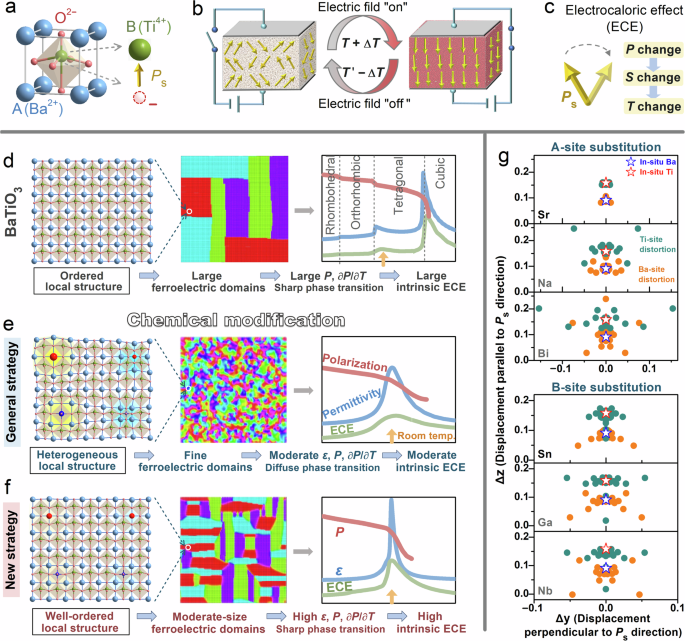
Chemical modification designed to achieve a well-ordered local structure
To achieve a well-ordered local structure while shifting TC downward to room temperature by chemical modifications, the modifying ions must have the same valence and similar ionic radii to those of Ba2+ (1.61 Å) and Ti4+ (0.605 Å) in the BaTiO3 perovskite structure. This ensures that significant lattice distortions or the introduction of vacancy defects into the local structure of BT are prevented, thus helping to preserve high intrinsic ferroelectric polarization and a pronounced phase-transition dielectric peak30. Additionally, the modification ions should create a small lattice energy difference to ensure minimal lattice distortions. Based on these assumptions, Sr2+ (1.44 Å) and Sn4+ (0.69 Å) are selected as the primary modification ions in comparison to other possible candidates. Figure 1g presents the theoretical estimation of lattice distortion in BT resulting from different ion substitutions at the A and B sites, while Supplementary Fig. S1 shows the lattice energy differences between adjacent ions occupying A or B sites, oriented either parallel or perpendicular to the Ps vector. The DFT results demonstrate that Sr2+ occupying A sites and Sn4+ occupying B sites introduce minimal disruption to BT’s ordered local structure compared to other substitutions. This low level of lattice distortion in BT supports a more uniform structural evolution, enabling a rapid and coherent phase transition across the ferroelectric matrix under thermal or electrical stimuli. Meanwhile, the minimal lattice distortion suggests a low ion positioning energy preference31, promoting a homogeneous distribution of the modification ions within the BT matrix. In contrast, dopants such as Na+/Bi3+ or Ga3+/Nb5+ on the Ba2+ or Ti4+ sites, respectively, exhibit significantly higher energy difference, either parallel or perpendicular to the Ps direction, leading to a selective ion positioning preference or even clustering of the ions. This accounts for a significant lattice distortion and the formation of local structural heterogeneity, ultimately disrupting long-range ferroelectric orders, leading to reduced ferroelectric polarization and a more diffuse phase transition27. Collectively, these findings highlight that Sr2+ and Sn4+ are effective modification ions for achieving a well-ordered local structure in BT with the desired effects.
Phase transitions and electrical properties
Figure 2a illustrates the temperature dependence of dielectric constant (εr–T) for BT and BST-xBSS ceramics. The primary goal of introducing Sr2+ and Sn4+ is to effectively shift the TC of BT toward room temperature, meanwhile preserving the well-ordered local structure and ferroelectric orders, due to the minimal lattice distortion induced by these ions (Fig. 1g and Supplementary Fig. S1). The TC of BST-xBSS decreases from approximately 125 °C (for pure BT) to room temperature as x increases from 0.04 to 0.10. This shift is attributed to a reduced Landau free energy difference between the ferroelectric and paraelectric phases, caused by the incorporation of the modification ions31, which facilitates the phase transition and results in the observed decrease in TC. Concurrently, the phase-transition temperatures of the rhombohedral-orthorhombic (R-O, TR-O) and orthorhombic-tetragonal (O-T, TO-T) phase transition approach the room temperature TC, i.e., this shift transforms the room-temperature phase structure from a tetragonal phase (x = 0.04) to a ferroelectric multiphase coexistence (x = 0.06 and 0.08), and eventually to a TC peak below room temperature (x = 0.10), as corroborated by the phase diagram (Supplementary Fig. S2), Rietveld refinement of X-ray diffraction data (Supplementary Fig. S3 and Table S1), and Raman spectra (Supplementary Fig. S4). Integrating the temperature-dependent Raman spectra presented in Fig. 2b and Supplementary Fig. S5, it is evident that the convergent and successive R-O and O-T ferroelectric phase transitions nearing the TC peak are observable at x = 0.08 near room temperature. The phase convergence contributes to a pronounced phase-transition dielectric peak due to the multiphase critical point effect32. The ferroelectric phase structure remains metastable as it approaches the TC peak. Despite this metastability, distinct ferroelectric phase transitions are observed at x = 0.08, unlike at x = 0.10, where transitions completely merge into the TC peak. This indicates that this metastable ferroelectric structure retains significant ferroelectric polarization at x = 0.08. Furthermore, the incorporation of Sr2+ or Sn4+ into the BT matrix leads to the formation of nanosized domains, enhancing local polarization and dielectric response33,34. Consequently, BST-xBSS exhibits a high dielectric constant and dielectric anomalies at ferroelectric–ferroelectric and ferroelectric–paraelectric phase transitions, where the sharp ferroelectric–paraelectric phase transition mirrors the rapid phase transition observed in pure BT.

a Temperature-dependent dielectric constant of BT and BST-xBSS ceramics. b Temperature-dependent Raman spectra for BST-0.08BSS. c Comparison of room-temperature maximum polarization (Pm), remnant polarization (Pr), coercive field (Ec), dielectric constant (εr), and longitudinal piezoelectric coefficient (d33) between BT and BST-0.08BSS. d Polarization-electric field (P–E) loops, e polarization change rate with temperature (∂P/∂T), f electrocaloric strength (ΔT/ΔE), and g electric field-induced heat flow curves (near room temperature) for BST-0.08BSS. h Comparison of ΔT/ΔE at room temperature between BT and BST-0.08BSS. i Comparison of ΔT/ΔE between this work and other lead-free and some typical lead-based ferroelectric ceramics near room temperature.
The Curie–Weiss temperature (TCW) and the temperature (Tm) at which maximum dielectric constant (εm) occurs can be determined from the 1/εr–T curves (Supplementary Fig. S6a). TCW denotes the temperature where the dielectric constant deviates from the Curie–Weiss law. Thus, the difference TCW–Tm serves as an indicator of the phase transition’s diffuseness35. Moreover, the diffuseness can be quantified using the diffuseness coefficient (γ) derived from the modified Curie–Weiss equation36:
$$1/{\varepsilon }_{{{\rm{r}}}}{{\rm{\hbox{ – }}}}1/{\varepsilon }_{{{\rm{m}}}}={(T-{T}_{{{\rm{m}}}})}^{{{\rm{\gamma }}}}/C (1\le {{\rm{\gamma }}}\le 2)$$
(4)
where C is the Curie constant. The value of γ is obtained from the slope of the ln(1/εr–1/εm) versus ln(T–Tm) plot (Supplementary Fig. S6b). Both γ and TCW–Tm exhibit a gradual increase with rising x (Supplementary Fig. S6d, e), indicating that the phase transition becomes diffuse. This increased diffuseness is attributed to the addition of Sr2+/Sn4+, and the formation of smaller ferroelectric domains following Sr2+/Sn4+ incorporation34,37. Despite the enhanced diffuseness, the dielectric peak remains sharp after Sr2+/Sn4+ incorporation. Based on the normalized εr–T curves (Supplementary Fig. S6c, f–h), two parameters, WR-L and WR-H, are employed to characterize the breadth of the dielectric peak at TC38. The low-temperature side of the TC peak broadens slightly, whereas the high-temperature side narrows significantly after introducing Sr2+/Sn4+, culminating in a narrower phase-transition temperature range (i.e., a sharper phase transition) in BST-xBSS. Consequently, BST-0.08BSS not only manifests a high dielectric peak with a giant dielectric constant but also exhibits a sharp phase transition with an obvious ferroelectric phase existing near room temperature. This swift ferroelectric–paraelectric phase transition, coupled with the giant dielectric constant and significant ferroelectric polarization, greatly benefits the intrinsic EC effect near room temperature.
The room-temperature polarization-electric field (P–E) loops, maximum polarization (Pm), remnant polarization (Pr), coercive field (Ec), εr, and longitudinal piezoelectric coefficient (d33) of the ceramics are displayed in Fig. 2c and Supplementary Fig. S7. Pure BT exhibits P–E loops characterized by high Pm, Pr, and Ec. In contrast, BST-xBSS displays slim P–E loops with reduced Pm and Pr, and markedly lower Ec. For instance, comparing BT and BST-0.08BSS, Pm/Pr decreases from 20.0/12.2 to 15.0/4.8 μC/cm2, while Ec declines sharply from 3.0 to 0.35 kV/cm. The significantly lower Ec suggests easier polarization rotation and domain switching in BST-0.08BSS. Despite the reduction in Pm and Pr, BST-0.08BSS exhibits a higher polarization change (ΔP = Pm – Pr) compared to pure BT, increasing from 7.8 to 10.2 μC/cm2, reflecting improved polarization variation efficiency. The combination of relatively high polarization, easy polarization change, and convergent ferroelectric phase transitions results in enhanced dielectric constant for BST-xBSS32,34. For example, a colossal εr of approximately 12,400 is achieved in BST-0.08BSS at room temperature, more than five folds greater than the εr (~2450) of pure BT. According to the phenomenology relationship of d33 ∝ Pr·εr39, d33 is directly proportional to the product of Pr and εr. Consequently, the colossal εr and high Pr culminate in a giant piezoelectric response, with d33 reaching approximately 800 pC/N in BST-0.08BSS. This high piezoelectric response further corroborates the robust ferroelectricity and easy polarization rotation in BST-0.08BSS.
Intrinsic electrocaloric property
The electrocaloric (EC) property of conventional ferroelectrics can be accessed via indirect and direct methodologies40. The indirect approach relies on Eq. (1) and the polarization change rate with temperature (∂P/∂T). To determine ∂P/∂T, the temperature dependence of P–E loops and polarization under various electric fields for BST-0.08BSS are measured, as depicted in Fig. 2d and Supplementary Fig. S8a. The polarization values are derived from the Pm in P–E loops, and the polarization at 0 kV/cm is inferred from the Pr value. According to polarization versus temperature (P–T) curves, polarization exhibits a decreasing trend with increasing temperature. That is, ∂P/∂T is consistently negative, and its evolution as a function of temperature and electric field is illustrated in Fig. 2e. The maximum absolute value of ∂P/∂T appears near TC, especially under low electric fields. At higher fields, polarization can be induced even above TC, causing the peak of ∂P/∂T to shift toward higher temperatures as the electric field increases. According to Eq. (1) and the obtained results (Fig. 2e and Supplementary Fig. S9), the EC temperature change (ΔT) and EC strength (ΔT/ΔE) can be derived, as illustrated in Fig. 2f and Supplementary Fig. S8b. ΔT/ΔE and ΔT also peak near TC regardless of the applied electric field. Like ∂P/∂T, the ΔT/ΔE and ΔT peaks also shift to higher temperatures with increasing electric field.
To further validate the EC performance, the direct method using differential scanning calorimetry (DSC) heat flow measurements is employed to estimate the EC response of BST-0.08BSS near room temperature. As illustrated in Fig. 2g, exothermic and endothermic heat peaks induced by the EC effect are observed upon applying and removing the electric field, respectively, and the EC performance is calculated from the areas of these heat peaks. The calculated ΔT/ΔE and ΔT values from both indirect and direct methods are consistent. As shown in Fig. 2h, the room-temperature ΔT/ΔE significantly increases from pure BT to BST-0.08BSS, with the highest value reaching approximately 1.0 K·mm/kV. This will lead to a high ΔT under a low electric field, for example, ~0.25–0.4 K can be obtained under 2.5–5 kV/cm (Supplementary Fig. S8b). Based on Eqs. (1)–(3), EC performance is directly related to polarization and dielectric constant. Therefore, the excellent intrinsic EC response in BST-0.08BSS can be attributed to the giant dielectric constant and high polarization, as well as the large polarization variation induced by the easy polarization rotation and rapid phase transition near room temperature. Ultimately, the remarkable EC effect observed in BST-0.08BSS surpasses not only actively studied BT-based ceramics, but also lead-free ferroelectrics such as (K, Na)NbO3 (KNN)- and (Bi0.5Na0.5)TiO3 (BNT)-based ceramics11,13,18,19,20,21,22,23,41,42,43,44,45,46, as well as lead-based PMN-10PT, PST, PLZT, and PMN ceramics2,47,48,49, as shown in Fig. 2i. Thus, this study successfully demonstrates a significant intrinsic EC performance by employing an innovative strategy that combines rapid phase transition with high polarization variation and giant dielectric constant near room temperature by local well-ordered structural engineering.
link