Humanoid finger with rigid-flexible-soft structure
Experimental preparation
To comprehensively analyze the mechanical properties of the HFRFSS, we conduct a series of experiments to evaluate its fingertip output force, gripping force, stability against external impacts, resistance to unnatural deformation, and manipulation reliability. Moreover, we also refer to the widely used structures in this field and fabricate a pure soft finger (PSF)47, a pure rigid finger (PRF), and a wire-driven system finger (WSF, a typical type of hybrid-structure finger) with dimensions similar to HFRFSS, to clearly compare the performance of HFRFSS with various common gripper designs in this field. The specific structure and production process of PSF, PRF, and WSF are presented in Supplementary Note S3.
Fingertip output force evaluation
To evaluate the actuation power of the HFRFSS, we examine the output force of the fingertip at certain pressure \(\) and different bending angles \(\theta\). Here, \(p\) is the cavity pressure expressed as gauge pressure (relative to atmospheric pressure), and \(\theta\) denotes the included angle of the central axis between the distant phalanx in its current bent state and its relaxed state, as illustrated in Fig. 2b. In the experimental setup, the humanoid finger is attached to the end of a six-degree-of-freedom robotic arm with its cavity pressure p held constant, and its fingertip is positioned atop a force sensor. The robotic arm operates to manipulate the finger, adjusting the bending angle \(\theta\), while the force sensor measures the output force of the fingertip at different \(\theta \,\)(Fig. 2a).

a Schematic diagram of the experimental device for evaluating fingertip output force (the “shooting range” marked in the figure represents the angle of the photo taken in the next figure, and the same applies to Fig. 2d, h, k, o \({p}\) denotes the force applied to the force sensor, and the same applies to Fig. 2b, d, e, k, l). b Experimental photo of fingertip output force evaluation. c Relationship between fingertip output force and finger bending angle. d Schematic diagram of the experimental device for evaluating finger embracing force. e Experimental photo of embracing force evaluation (subfigure ① represents HFRFSS, subfigure ② represents PSF, subfigure ③ represents PRF, subfigure ④ represents WSF, and the same applies to Fig. 2l, p, q). f Variation curve of embracing force of finger encirclement to the cylindrical gripping device with a diameter of 4 cm (the hollow inverted triangle marked in the figure represents the “extreme position” where PRF and WSF can wrap around the cylindrical gripping device normally. After crossing this position, the finger slips off. At this time, the measured embracing force collapse. The above situation also applies to Fig. 2g). g Variation curve of embracing force of finger encirclement to the cylindrical gripping device with a diameter of 5 cm. h Schematic diagram of an experimental device for stability against external influences. i Experimental photo of stability against external influences. j Relationship between lateral vibration amplitude and time of fingers after external impact. k Schematic diagram of experimental device for finger resistance to unnatural deformation. l Experimental photo of anti-unnatural deformation experiment. m Relationship between finger reverse bending angle and external force. n Relationship between finger lateral bending angle and external force. o Schematic diagram of the experimental device for finger manipulation reliability. p Experimental photo of finger manipulation reliability. q Comparison of the degree of surface damage and quality loss after grasping tofu with different fingers. (Source data are provided as a Source data file).
Figure 2c displays the experimental results, illustrating the measured output force of the fingertip at various bending angles \(\theta\) for cavity pressure \(p\) of \(-0.35\) bar, \(-0.55\) bar, \(-0.75\) bar and \(-0.95\) bar. The results indicate that, for a fixed bending angle \(\theta\), a larger pressure difference \({|p|}\) corresponds to a greater output force. Moreover, at a fixed cavity pressure \(p\), an increased bending angle \(\theta\) would result in a smaller output force. In the experiment, a pressure of \(-0.95\) bar is applied to the finger, which is the extreme negative air pressure that the pneumatic control system used in this paper can achieve, corresponding to a maximum output force of approximately 4.0 N. This metric meets the target specifications listed in Table 1, which serves as a crucial reference during the design of the HFRFSS. Observing Fig. 2c, we discern the potential of HFRFSS to manipulate the cavity pressure \(p\) for adjusting the bending angle \(\theta\) while maintaining the output force, which enables the grasping of objects of equivalent weight yet varying sizes. Moreover, by adjusting \(p\) to achieve different output forces while keeping \(\theta\) fixed, we can achieve the grasping of objects of the same size but different weights.
Embracing force evaluation
We assess the finger’s ability to stably hold objects by evaluating its embracing force, which is defined as the finger output force that needs to be overcome during the process of forcefully pulling an object embraced by fingers out of the embracing range. The experimental setup is depicted in Fig. 2d, in which the HFRFSS, placed in a horizontal plane, is mounted at the end of the robotic arm, and embraces a cylindrical grip device attached to a force sensor. In the experiment, the extreme cavity pressure of \(p\)=\(\,-0.95\) bar is applied to the finger, and the robotic arm propels the gripping device to move at a constant speed of 2 cm/s along the direction of the relaxed state finger (Fig. 2e), pulling the device out of the finger’s embrace. During this movement, the force sensor measures the pulling force exerted by the robotic arm, which numerically corresponds to the embracing force of the HFRFSS.
The experiments are conducted using cylindrical grip devices with diameters of 4 and 5 cm, respectively, to measure the embracing forces of the designed HFRFSS when embracing objects of different sizes. We also conduct similar experiments with PSF, PRF and WSF for comparative analysis (Fig. 2e). The results are shown in Fig. 2f, g. According to the figures, the embracing forces of the HFRFSS to the grip devices with diameters of 4 and 5 cm are approximately 8.5 and 8.3 N, respectively. The HFRFSS provides an embracing force about 3.5 times higher than that of the PSF, which also uses pneumatic actuation. Meanwhile, it is about 85% of the embracing force of the WSF and about 65% of that of the PRF, respectively. In addition, as depicted in Fig. 2f, g, PRF and WSF exhibit a mechanical limit (denoted by the red triangular markers in the figures). Exceeding this limit results in slippage and failure to maintain object grasp, primarily due to insufficient compliance. In contrast, HFRFSS and PSF maintain smooth and stable hugging forces throughout the entire motion range due to their excellent compliance. These results demonstrate that HFRFSS offers greater embracing force than that of traditional soft fingers while avoiding the slippage when rigid fingers reach their mechanical limit, generating a continuous and smooth embracing force.
In addition, we test the embracing force of human fingers through this experimental platform. Supplementary Note S4 records the specific experimental process and a comparison chart of HFRFSS, PSF, and human finger’s embracing force. Based on comparative data, the embracing force of HFRFSS is significantly superior to that of PSF, but it is still slightly inferior to that of an adult finger.
Stability against external impacts
We test the stability of the HFRFSS through the experimental platform shown in Fig. 2h. As depicted, the HFRFSS is positioned in a vertical plane, with its fingertip pointing upwards and the other end fixed to the table. In this experiment, we employ the robotic arm to propel a hammer horizontally toward the fingertip of the HFRFSS at a constant speed of 1 m/s, generating a sudden external impact. Following the impact, the lateral vibration of the fingertip is recorded using a laser distance sensor to evaluate the stability of the HFRFSS (Fig. 2i). Similar experiments for the PSF, PRF, and WSF are also conducted for comparative analysis.
Figure 2j displays the experimental results for recorded lateral vibration. As shown in the figure, the vibration amplitude of the HFRFSS is approximately 40% of that of the PSF, 85% of that of the WSF, and 105% of that of the PRF. Moreover, the HFRFSS can rapidly recover back to near its relaxed state in about 0.5 s. These properties validate the strong stability of the HFRFSS against external impacts.
Resistance to unnatural deformation
Unnatural deformation of a humanoid finger refers to deviations from natural finger bending under external forces, such as outward and transverse bending. In this section, we conduct experiments to evaluate the resistance of the HFRFSS against such deformations by measuring the external forces required to cause unnatural bending at different angles.
The experimental setup is shown in Fig. 2k, where the fingertip of the HFRFSS is positioned within a ring-like structure, attached to a force sensor, and mounted at the end of the robotic arm. In experiments, the HFRFSS is placed in a horizontal plane with its naturally curved side facing upward and resists unnatural bending as the robotic arm propels the ring downwards. The ability of the HFRFSS to resist outward bending is assessed by measuring pulling forces (Fig. 2l). Similarly, the ability of the HFRFSS to resist transverse bending is assessed when the finger is positioned horizontally with its naturally curved side facing inward (Fig. 2l). Comparative experiments are conducted for PSF, PRF and WSF.
The experimental results are presented in Fig. 2m, n. According to the figures, for the same degree of outward bending, the pulling force required for HFRFSS is about 200–250% larger than for PSF, which is close to PRF but only about 50% of WSF. For the transverse bending, HFRFSS requires a tensile force approximately 300–450% larger than PSF, surpassing PRF and reaching around 85% of WSF. Moreover, when the outward bending and transverse bending angles reach 20 degrees, it is considered the limit of the payload capacity of the fingers. At this point, the HFRFSS can withstand external forces of 5.31 and 9.32 N, respectively, while also meeting the target specifications in Table 1. This experiment confirms that the designed HFRFSS demonstrates superior resistance to unnatural deformation and exhibits a high payload capacity, which enable HFFRSS to grasp and hold objects better.
Manipulation reliability
We evaluate the manipulation reliability of the fingers by assessing their stability when gripping soft and fragile objects, as well as the degree of damage caused to the objects during the grasping process. The experimental setup is shown in Fig. 2o. The HFRFSS-based two-finger gripper is attached to the end of a robotic arm, and a piece of soft and fragile tofu is placed on the platform directly below the gripper. The whole grasping motion involves descending the gripper to pick up the tofu, lifting it for a period of time, placing the tofu back onto the platform (Fig. 2p), and finally restoring the gripper to its original position. The experiment is repeated consecutively 20 times. Meanwhile, we take photos of the tofu’s surface and measure its weight before and after the experiment, respectively, to evaluate the damage caused during the grasping process. For comparison, the experiment is also conducted using two-finger grippers based on PSF, PRF, and WSF, videos of these experiments are provided in the Supplementary Movie S1.
The experimental results are presented in Fig. 2q. As shown in the figure, the HFRFSS-based two-finger gripper causes hardly any visible damage to the tofu’s surface, and the loss of tofu mass is only 0.06 g, which is almost negligible. The PSF-based two-finger gripper also shows similar results. In contrast, the grippers based on PRF and WSF both leave noticeable indentations on the tofu’s surface, and result in a 1.13 and 0.92 g loss of mass, respectively. These results demonstrate that the HFRFSS exhibits excellent manipulation reliability for handling soft and fragile objects.
For objects of various shapes and weights, the gripper requires different poses and output forces to achieve a stable grasp. To analyze the stability and reliability of HFRFSS when grasping objects of different shapes and weights, we conduct experiments using the HFRFSS-based two-finger gripper to consecutively grasp a box with different loads. There are 10 groups of experiments tasked with grasping the same object, each comprising 20 grasps. The specific process of the experiment can refer to Supplementary Note S5 and Movie S2, and the experimental results are shown in Fig. S9.
The experimental results show that, despite the substantial differences in shape and weight between the box and the tofu, the HFRFSS-based two-finger gripper achieves 20 times successful consecutive grasps in each of the 10 groups of experiments when grasping an empty box weighing 124 g and the box with a 200 g load. However, when grasping the box with a 500 g load, the gripper experiences grasping failures, and the average number of successful consecutive grasps in each group of experiments is 5.8 times. The main reason for grasping failure is that as the load weight increases, there will be a certain deviation in the placement of the box during each time the gripper grasping and returning it. Hence, multiple grasps accumulate larger placement deviations, resulting in a decrease in the number of consecutive successful grasps. Such a deviation could potentially be compensated for by developing more precise control methods in future work.
HFRFSS grippers
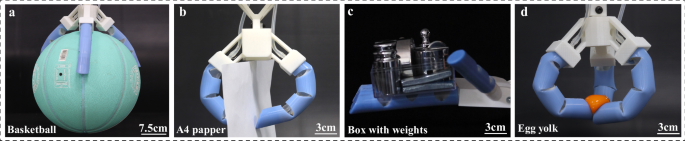
We employ the designed HFRFSS to construct two grippers—a 124.4 g two-finger gripper and a 160.5 g three-finger gripper. The grasping ability of these grippers is experimentally assessed through a series of experiments, demonstrating their ability to stably grasp objects of different weights and sizes, as shown in Fig. 3. The objects in Fig. 3 are carefully selected based on the functional requirements of the HFRFSS in grasping tasks. Specifically, ultra-thin or ultra-fragile objects, such as tofu, egg yolk, A4 paper, potato chips, and balloon, are chosen to validate the HFRFSS’s ability to handle such objects, while large or heavy objects, such as 3D-printed material, cabbage, and basketball, are used to demonstrate its capability to handle common large or heavy objects. To standardize the grasping process, we develop a grasping protocol. During each grasping process, we ensure that the object being grasped leaves the platform by more than 3 cm and maintains a stable grasping time of more than 5 s. The videos of all grasping experiments in Fig. 3 are presented in the Supplementary Movies S3 and S4. We have listed the relevant parameters of all experimental subjects in Tables S2 and S3 of the Supplementary Note S5.

a Grasp a cherry tomato weighing 12.1 g. b Grasp a piece of tofu weighing 32.3 g. c Grasp a kiwifruit weighing 126.4 g. d Grasp a roll of 3D printing consumables with a total weight of 1125.2 g. e Grasp an egg yolk weighing 14.7 g. f Grasp an egg weighing 48.5 g. g Grasp a weight of 500.0 g. h Grasp a cabbage weighing 1254.5 g. i Grasp a 0.01 cm thick A4 paper. j Grasp a 4.3 cm wide potato chip. k Grasp a 19.1 cm wide cardboard box. l Grasp a 25.0 cm long 3D printing rod. m Grasp a pencil with a diameter of 0.6 cm. n Grasp a beverage can with a diameter of 7.2 cm. o Grasp a basketball with a diameter of 23.2 cm. p Grasp a balloon with a diameter of 24.3 cm.
In the figure, Fig. 3a–d display the two-finger gripper progressively handling increasingly heavier objects, starting with gently grasping a 12.1 g cherry tomato and culminating in successfully grasping a pile of 3D printing consumables weighing 1125.2 g. Similarly, Fig. 3e–h show that the three-finger gripper is capable of not only gently grasping a delicate 14.7 g raw egg yolk without damaging it, but also securely holding a 1254.5 g cabbage. Additionally, Fig. 3i–l show the two-finger gripper transitioning from grasping an ultra-thin 0.01 cm sheet of A4 paper to handling a 25.0 cm length 3D printing rod, while Fig. 3m–p demonstrate the three-finger gripper picking up objects ranging from a 0.6 cm diameter pencil to a large, soft, and puncture-prone 24.3 cm balloon. These experiments validate the superior grasping ability of the constructed grippers across a broad spectrum of weights, hardness, sizes, and shapes.
Furthermore, we conduct additional experiments to evaluate the repeatability and error rate during the process of grasping soft and fragile objects (taking tofu as an example). In the experiments, the two-finger gripper repeatedly grasps tofu 20 times, with the number of successful and failed attempts recorded. The results demonstrate that the two-fingered gripper achieves a 100% success rate in grasping tofu continuously, indicating that the HFRFSS has satisfactory repeatability and a very low error rate.
Then, we construct a five-finger humanoid hand weighing 260.0 g with the designed HFRFSS. As shown in Fig. 4, demonstrations of its ability include supporting a box with 5.275 kg weights in total (Fig. 4a), holding a 1.55 kg bottle of beverage (Fig. 4b), and lifting a basket with 4.35 kg weights in total (Fig. 4c). Unlike conventional pure soft hands or rigid-soft hybrid hands that often have limited bearing capacities, the humanoid hand constructed with our designed HFRFSS can carry large weights while resisting unnatural bending.

a Five-finger humanoid hand supports a box with 5.275 kg weights in total. b Five-finger humanoid hand holds a 1.55 kg bottle of beverage. c Five-finger humanoid hand lifts a basket with 4.35 kg weights in total.
Table 2 compares the parameters of HFRFSS with existing soft robotic grippers and rigid-soft structure grippers. Here, the performance of the gripper is quantitatively evaluated by the bearing capacity-quality ratio, defined as the weight of the heaviest object successfully grasped under a given mode normalized by the mass of the gripper, where the mass is taken from the reported values for the specific gripper type in the cited references and the bearing capacity reflects the documented highest payload achieved in the corresponding grasping mode. We follow the standards outlined in ref. 27 to categorize the grasping modes of the listed grippers into clamping and enveloping grasping. Furthermore, we refer to the standards provided in ref. 48 to classify the grasping modes of the listed humanoid hands into holding, lifting, and supporting. According to Table 2, it is clear that the grippers with HFRFSS have an advantage in terms of bearing capacity-quality ratio in the actions of clamping, holding, lifting and supporting. Only in the enveloping grasping action, the bearing capacity-quality ratio of the gripper in this work is lower than that reported in ref. 49, yet it still achieves a ratio of 781.9%. In the action of supporting, which is shown in Supplementary Movie S5, the bearing capacity-quality capacity ratio of the humanoid hand with HFRFSS reaches 2028.9%, which is the highest value in Table 2, meaning that it can carry a load approximately 20 times its own weight. It can also be seen that the HFRFSS has excellent performance in grasping soft objects. The combination of multiple materials endows the HFRFSS with sufficient strength and flexibility, enabling it to handle various object manipulation tasks efficiently.
The HFRFSS is also capable of grasping objects from various angles. We designed an experiment to consecutively grasp and release a potato chip from the rear-right, right, front-right, oblique-above, and directly-above positions (Video files can refer to Supplementary Movie S6), thereby demonstrating the grasping ability of the HFRFSS under more dynamic task conditions.
link