ISO design manual opens the door for structural bamboo
The use of bamboo for construction has reached a critical milestone with the release of the Manual for the Design of Bamboo Structures to ISO 22156:2021, published by the Institution of Structural Engineers. It is the first structural engineering manual for bamboo in the world.
Authored by four international engineers familiar with this prolific bio-based material, the manual opens the door for architects and AEC professionals to better understand how bamboo can be incorporated into building design.
By promoting the application of the current ISO 22156:2021 standard, the most widely accepted international bamboo standard since the 2000s, the manual will hopefully lead to bamboo’s integration into building codes around the world.
Mass timber construction (MTC) has found acceptance in North America and in Europe as a viable alternative, or hybrid partner, to steel and concrete. One thing to keep in mind, however, is the trees harvested and ultimately transformed into high-strength beams, columns and panels take many years to grow. On the other hand, bamboo is a remarkably fast growing plant. Some species can reach harvesting height in only five years and can regrow quickly.
The authors say bamboo forestry can also offer important environmental benefits.
“Compared to trees, bamboo offers a faster path to widespread adoption of structural bio-based materials for construction, especially in parts of the world with no significant commercial forestry.”
The authors explain in addition, “bamboo can be used to restore degraded soils, so it does not compete with agricultural lands or existing primary forests. Instead, bamboo can provide a series of environmental services, including erosion control on slopes and riverbanks, water flow regulation and creating a windbreak in shelterbelts.”
There are over 1,600 known species of bamboo grow in nearly all continents, with numerous species successfully introduced into Europe and Canada. Some species of bamboo possess remarkable structural properties comparable to hardwoods.
Bamboo culms can be split into strips, treated and then laminated into panels and flooring that is stronger and harder than hardwood. In fact, bamboo has been used for flooring and decking for some time in Canada with excellent results. However, as a structural component, laminated bamboo has the potential to do much more.
“Structurally, bamboo has remarkable mechanical properties,” said manual co-author Kent Harries, professor of structural engineering and mechanics at the University of Pittsburgh. “It has also become a very promising bio-based resource, with growing credentials as a sustainable construction material. Nonetheless, this is hugely dependent on designing and building safe and durable structures. Our detailed manual helps to achieve this.”
Attaining the next stage of acceptance as a structural building material has been a challenge to this point, said manual co-author Dr. David Trujillo, assistant professor in humanitarian engineering, school of engineering, University of Warwick.
“Unfortunately, the countries that had the expertise in developing construction codes to regulate the design and building of structures were not those interested in bamboo. For this to change, international collaboration was needed.”
Canada is one of the many western countries yet to accept structural bamboo into national building codes. However, there are examples of bamboo structures elsewhere.
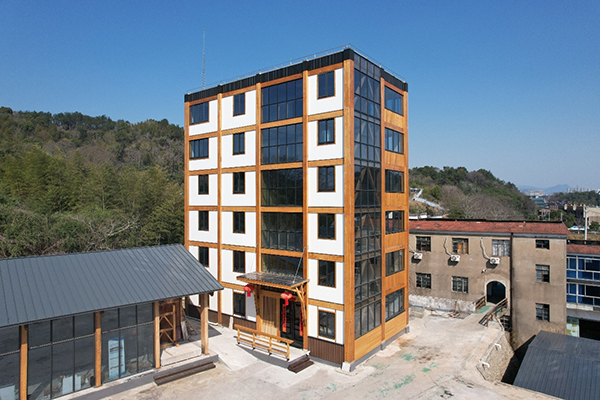
The Ninghai Bamboo Tower in the port city of Ningbo, China, is a seven-storey mid-rise structure of 20.3 metres in height and with a floor area of 720 square metres. It has been constructed almost entirely of composite engineered bamboo structural materials. Laminated beams and sheet materials were used for the post-and-beam construction, floors, walls and carrier beams for the floors and roof, with wall elements in steel.
The project won three prestigious awards at the 2025 Architectural Engineering Institute Conference hosted by the American Society of Civil Engineers: the Most Innovative Project of 2025, the Award Excellence in Structural System Design and the Award of Merit in Building Integration Sustainability and Lifecycle Performance.
As ASCE-AEI chair Dr. Linda Foster commented, “This project proves bamboo isn’t just symbolic — it’s a structurally sound, scalable solution for the climate crisis.”
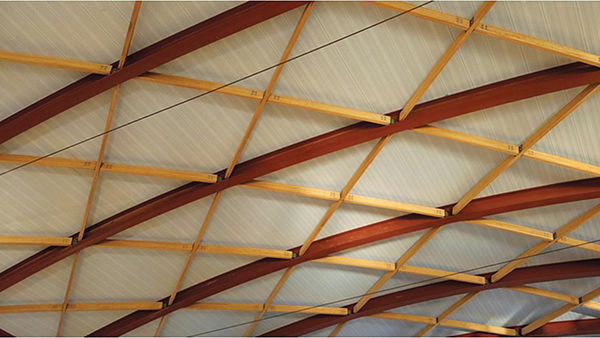
Engineered bamboo has reached North American shores, notably in a domed roof created in 2016. The structure was designed by architecture and engineering firm RS&H as a hybrid steel-and-bamboo cross bracing for the Williamson County Regional Airport terminal in Marion, Illinois.
The authors hope the new manual, available at no cost, will empower engineers and designers around the world to expand the adoption of bamboo as a viable building material.
John Bleasby is a freelance writer. Send comments and Climate and Construction column ideas to [email protected].
link