Numerical simulation and design recommendations for prestressed steel stayed columns subjected to static and dynamic effects
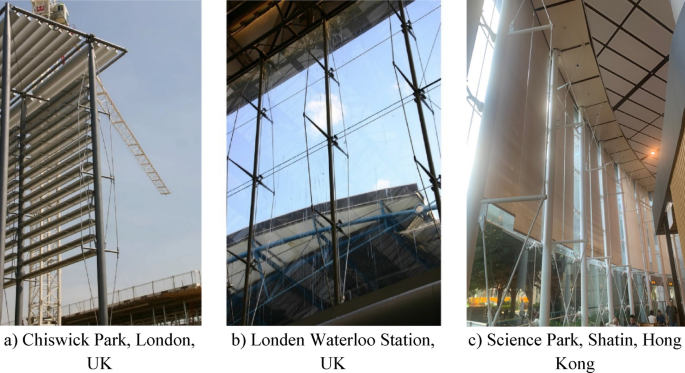
The FE capabilities of ABAQUS are utilized to comprehensively analyze the static and dynamic behavior of PSCs. An automated modeling framework is developed using Python scripting to efficiently generate and manage the entire model setup. This framework defines node coordinates, element connectivity for the main column, cross-arms, and cable stays, and accommodates complex configurations such as multi-level PSCs and stayed frames. Critical modeling parameters—including geometry, mesh refinement, material properties, loading schemes, boundary conditions, and analysis types—are systematically integrated into the automated process to ensure consistency and accuracy across simulations.
Modeling parameters
To investigate the behavior of PSCs under various buckling and failure modes, a line-based FE model (LFEM) is employed. The LFEM utilizes beam elements (B23 for 2D analysis and B32 for 3D analysis) to model the column and cross-arm, while B32 beam elements were adopted for the 3D models. These were selected due to their efficiency and suitability in modeling slender beam–column elements under axial and flexural loading. For the stays, truss elements (T2D2 for 2D analysis and T3D2 for 3D analysis) with “No compression” behavior are used, enabling tension-only response. This approach allows each cable to be modeled individually, ensuring accurate representation of its response under different loading conditions.
The geometric and material properties of PSCs play a critical role in defining their structural behavior. Key geometric parameters include the column length (\({L}_{c}\)) and cross-arm length (\(a\)). The cross-sectional dimensions are defined by the outer and inner diameters of the column (\({D}_{co}\), \({D}_{ci}\)), the cross-arm (\({D}_{ao}\), \({D}_{ai}\)), and the stay diameter (\({D}_{s}\)). The material properties are defined by the Young’s modulus of the column (\({E}_{c}\)), cross-arm (\({E}_{a}\)), and stays (\({E}_{s}\)). In cases involving multi-level cross-arm configurations or varying arm geometries, a comprehensive set of dimensional parameters is employed to accurately capture the structural geometry and behavior. An illustrative example of geometric configuration is presented in Fig. 2.

Geometric configurations of PSCs.
The material properties of PSCs, particularly those of the steel components, play a critical role in structural analysis. The elastic properties, characterized by the modulus of elasticity (\(E\)) and Poisson’s ratio (\(\nu\)), determine the material’s stiffness and response to deformation. The yield stress represents the inelastic behavior (\({F}_{y}\)), where plastic deformation begins. In this study, an elastic-perfectly-plastic constitutive model is employed for the steel column. This approach effectively captures both the elastic and plastic phases of deformation, enabling a detailed and accurate analysis of the PSCs’ response under various loading conditions. The meshed size of the main member and crossarms is 50 mm, and each stay is meshed as an individual element.
Boundary conditions and loading scenarios
The connections between the stays and the main column, as well as between the stays and cross-arms, are modeled as ideal pins using coupling constraints to ensure consistent displacement behavior between the stays and the cross-arms. This approach enforces equilibrium at the connection points and accurately simulates the interaction between these components.
The connections between the cross-arms and the main column are modeled as rigid for both static and dynamic analyses. The boundary conditions at the reference nodes on both ends are defined by the degrees of freedom (Ux, Uy, Uz, Rx, Ry, Rz), enabling the specification of arbitrary constraints within the proposed automated FE routine. Where Ux, Uy, and Uz denote translational displacements along the x-, y-, and z-axes, respectively, and Rx, Ry, and Rz represent rotational displacements about the corresponding axes.
For the static analysis, a concentrated load is applied at the top of the column. In the dynamic analysis, the system is subjected to seismic excitation based on an arbitrary time history scenario, with the El Centro earthquake applied in the X direction at the column base as a reference excitation. A lumped mass is assigned at the column’s center, and the time history amplitude is provided in tabular form. Direct modal damping is used to represent member viscosity, incorporating a specified critical damping ratio and time step (Δt). The member’s self-weight is excluded from dynamic analysis to isolate the effects of external loading conditions.
Prestress
The effect of prestress in cables is essential to the behavior and stability of PSCs. The relationship between prestressing force and critical buckling load offers a useful estimate for determining the required prestress. As shown in Fig. 3, understanding these variations in critical loads is crucial for optimizing the design and performance of PSCs. Initially, a prestressing force is applied to the cable stays to improve the PSCs’ load-bearing capacity. Figure 3 illustrates the correlation between critical buckling load and varying prestress levels, as observed in previous studies3.

Critical load NC versus the initial prestress T presented with zone distinction.
Zone 1 represents minimal prestressing force, where T < \({T}_{min}\). In this zone, the critical buckling load of the unstayed main column, also known as the Euler critical buckling load (\({P}_{E}\)), is reached under axial loading. In Zone 2, the prestressing force increases to \(T\) = [\({T}_{min}\), \({T}_{opt}\)], enhancing the column’s load capacity beyond the Euler load. However, at buckling initiation, the stays lose their tensile force. Zone 3 involves a higher prestressing force, ensuring residual tension in the stays when buckling begins. The optimal prestressing force \({T}_{opt}\), positioned at the boundary between Zones 2 and 3, maximizes the critical buckling load (\({N}_{max}^{c}\)). Hafez et al.3 provided the expression for this optimal force in single bay stayed columns as follows:
$$T_{opt} = N_{T = 0} \frac{{C_{1} }}{{C_{2} }}$$
(1)
$$T_{\min } = C_{1} N_{\min }^{c}$$
(2)
$$N_{min}^{c} = \left\{ \begin{gathered} N_{E } \quad \;\left( {mode 1} \right) \hfill \\ 4N_{E} \quad \,\left( {mode 2} \right) \hfill \\ \end{gathered} \right.$$
(3)
$$C_{1} = \frac{\cos \alpha }{{2K_{c} \left( {\frac{1}{{K_{S} }} + \frac{{2\sin^{2} \alpha }}{{K_{a} }} + \frac{{n\cos^{2} \alpha }}{{K_{c} }}} \right)}}$$
(4)
$$C_{2} = 1 + \frac{{n cos^{2} \alpha }}{{K_{c} \left( {\frac{1}{{K_{S} }} + \frac{{2sin^{2} \alpha }}{{K_{a} }}} \right)}}$$
(5)
where \({N}_{T=0}\) represents the buckling load when the initial pretension \(T\) equals zero. The parameters \({C}_{1}\) and \({C}_{2}\) are determined by the geometric configurations and material properties of the PSC. \({K}_{S}\), \({K}_{a}\), and \({K}_{c}\) represent the axial stiffness of the stays, cross-arms, and main column, respectively. \(\alpha\) is the angle between the main column and the stays. \(n\) is a parameter related to the typology of the stayed column (\(n=1\) for plane stayed column and \(n=2\) for spatial stayed column).
In the proposed FE framework, the prestressing effect for inclined cables is modeled using an initial temperature load. The prestressing step is performed before the loading step, where the temperature variation induces thermal strain (\(\varepsilon =\phi \Delta \tau\)) and generates the corresponding cable force. The cables were prestressed by using the thermal contraction of steel as it cools, to produce an internal tensile force. Here, \(\phi\) represents the thermal expansion coefficient, and \(\Delta \tau\) denotes the temperature change. As the cable temperature decreases, the cable force increases; hence, a negative temperature difference is applied to the prestressed cables, as follows32:
$$\Delta \tau = – \frac{\varepsilon }{\phi } = – \frac{\sigma }{{\phi * E_{s} }} = – \frac{P}{{\phi * E_{s} * A}}$$
(6)
where \({E}_{s}\) is the modulus of elasticity of the cable, A is the cross-sectional area of the cables, and P is the prestressing force. In the FE models, the optimum prestressing force (\({T}_{opt}\)), and the corresponding temperature change (\(\Delta\uptau\)) are applied to simulate the prestressing effect accurately.
Type of analysis
Eigenvalue buckling analysis was performed on an idealized (“perfect”) geometry to identify the potential buckling modes of prestressed steel stayed columns, as illustrated in Fig. 4. This idealization refers to a structure with no initial imperfections, residual stresses, or nonlinear material properties. All materials are assumed to behave in a linear-elastic manner, and loading is applied quasi-statically. Although this analysis does not replicate real-life conditions, it serves as a first-order approximation for predicting elastic buckling behavior.

Buckling mode shapes of PSCs; (a) Mode 1 (symmetric), and (b) Mode 2 (antisymmetric).
Eigenvalue buckling analysis—also known as linear buckling analysis—is a numerical method used to estimate the critical buckling load of a structure under ideal, unfactored conditions33. It determines the theoretical load at which a structure loses stability by solving an eigenvalue problem derived from the linearized equilibrium equations. This technique helps identify buckling mode shapes and their corresponding load multipliers, thereby revealing the most critical instability mechanisms in slender structural systems.
In this study, eigenvalue buckling analysis serves as a preliminary step in assessing the global stability of PSCs. It provides insights into dominant buckling modes, which inform and guide the subsequent nonlinear and dynamic analyses presented in the later sections of the paper. Mode 1 (symmetric) represents uniform bending along the column axis, while Mode 2 (antisymmetric) depicts opposing deformation patterns across the column’s axis.
This preliminary analysis is essential for predicting the column’s failure mode shapes, providing a reference for applying initial imperfection shapes in subsequent nonlinear static buckling analysis. The nonlinear analysis incorporated both geometric and material nonlinearities, offering a comprehensive insight into the column’s nonlinear buckling behavior and enabling a more accurate assessment of load-bearing capacity under realistic conditions.
In addition to examining static and buckling behavior, vibration and modal frequency analyses are critical to accurately determining damping coefficients, contributing to a more comprehensive design for PSCs. Time history analysis further enhances this assessment by enabling the evaluation of structural responses to dynamic loads, such as seismic activity, wind forces, and impact loads. The proposed FE framework is well-equipped to conduct these advanced analyses using implicit dynamic methods, ensuring robust and precise modeling under diverse loading scenarios.
Dynamic implicit analysis is especially effective for evaluating structural response to seismic events, as it employs an implicit integration scheme that prioritizes stability and accuracy over extended simulation periods. This approach solves the equations of motion with a focus on the system’s inertia, enabling the FE model to capture essential dynamic properties, including natural frequencies, mode shapes, and transient responses during realistic dynamic events34. A comprehensive flowchart of the FE routine is depicted in Fig. 5, illustrating the scripting process that includes model generation, job submission, and extraction of analysis results across diverse loading conditions and analysis types. Although the geometry of the single- and multiple-cross-arm PSCs is relatively simple, the automated script can generate any complex geometry, including models with multiple branches and cross-arms. Using joint coordinates and connectivity definitions, the column system, along with stays and arms, can be defined while accounting for various connection types and material properties. The applied loads may be static, dynamic, or seismic. Moreover, the script can handle column definitions using either line or shell elements, which is particularly important when local and global buckling behavior is to be studied. Composite columns, such as CFSTs, can also be generated using the same framework. This level of automation allows extensive parametric studies and facilitates design investigations efficiently. The JSON file serves as an input file containing key modeling parameters for the proposed framework (e.g., joint coordinates, connectivity, material properties, loads, boundary conditions, type of analysis, etc.)

Flowchart for the developed FE framework for PSCs.
link