Structural analysis and multi-objective optimization of sealing structure for cryogenic liquid hydrogen triple-offset butterfly valve
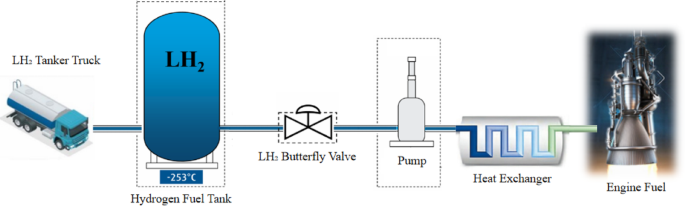
Theoretical analysis
Heat transfer theory analysis
In steady-state heat transfer problems, temperature change is independent of time:
$$\frac{{\partial T}}{{\partial t}}=0$$
(1)
Discretizing the object into elements, the temperature field \({T^e}(x,y,z)\) of an element is expressed as an interpolation function of nodal temperatures:
$${T^e}(x,y,z)=S(x,y,z)\left| {z_{T}^{e}} \right.$$
(2)
Where \(S(x,y,z)\) is the shape function matrix, and \(z_{T}^{e}\) is the nodal temperature vector:
$$q_{T}^{e}={\left[ {\begin{array}{*{20}{c}} {{T_1}}&{{T_2}}&{{T_3}}&{ \cdot \cdot \cdot }&{{T_n}} \end{array}} \right]^T}$$
(3)
Where \(T_{1} ,T_{2} , \cdot \cdot \cdot ,T_{n}\) is the nodal temperature value.
he annular gap between the bonnet and stem is simplified in the heat transfer model as a natural convection heat transfer problem in a closed cavity. In the heat transfer model, the annular gap between bonnet and stem is simplified and viewed as a problem of natural convective heat transfer in a closed cavity. The natural flow of fluid in this gap is determined by the \(G{r_\delta }\) (Grashof Number)24 of the length characterized by the thickness of the gap:
$$G{r_\delta }=\frac{{g{a_v}\Delta t{\delta ^3}}}{{{v^2}}}$$
(4)
Where g is the acceleration due to gravity; av is the volume thermal expansion coefficient of the fluid; Δt represents the temperature difference passing through the gap; δ is the characteristic length; v represents the dynamic viscosity of the fluid.
When the temperature difference \(\Delta t\) on both sides of the gap closure interlayer is small and Grδ << 2680, the natural convection effect in the gas medium is weak, and the gas heat transfer in the gap mainly considers heat conduction and heat radiation. Since the radiative heat transfer is proportional to the fourth square of temperature, it is negligible when the temperature difference is very small. For the heat transfer analysis of the annular air insulation, it can be equated to the steady-state thermal conductivity problem of a single-layer cylinder, which is:
$$q=\lambda \frac{{({t_1} – {t_2})}}{\varepsilon }A$$
(5)
Where A is the heat transfer area perpendicular to the heat flow direction; \(\lambda\) is the thermal conductivity; \(\varepsilon\) is the air layer thickness.
Relationship between valve cryogenic shrinkage and temperature gradient
Under ultra-low temperatures, material shrinkage can lead to sealing failure, jamming, or structural damage in valves. Given the thermal expansion/contraction properties of metals, the relationship between cryogenic shrinkage and temperature gradient can be quantified using the thermal expansion coefficient formula.
Linear expansion coefficient αt:
$${\alpha _t}dt=\frac{{dl}}{l}$$
(6)
Let \({l_{{t_2}}}\), \({l_{{t_1}}}\) be the component lengths at temperatures t2, t1 respectively. Integrating Eq. (6) gives:
$$\int_{{{t_1}}}^{{{t_2}}} {{\alpha _t}dt=\int_{{{l_{{t_1}}}}}^{{{l_{{t_2}}}}} {\frac{{dl}}{l}} }$$
(7)
Ultimately:
$${l_{{t_2}}}={l_{{t_1}}}{e^{{\alpha _t}\left( {{t_2} – {t_1}} \right)}}$$
(8)
Let Δt = t2–t1, As the ultra-low temperature medium flows in, the temperature continuously decreases (Δt < 0), Expanding the term \({e^{{\alpha _t}\left( {{t_2} – {t_1}} \right)}}\) in Eq. (8) using Taylor series:
$${e^{{\alpha _t}\Delta t}}=1 – {\alpha _t}\Delta t+\frac{1}{2}{\alpha _t}^{2}\Delta {t^2} – \frac{1}{6}{\alpha _t}^{3}\Delta {t^3}+ \ldots$$
(9)
Substituting Eq. (9) into Eq. (8) and neglecting higher-order terms:
$${l_{{t_2}}}={l_{{t_1}}}\left( {1-{\alpha _t}\Delta t} \right)$$
(10)
LH2 butterfly valves are typically designed at room temperature but used under cryogenic conditions. Therefore, using room temperature (20 ℃) as the reference temperature, the radial and axial shrinkage at the LH2 temperature range (−253 ℃) can be calculated based on the thermal expansion formula, providing a theoretical basis for designing the clearance fits between components of the cryogenic butterfly valve.
Calculation of required specific sealing pressure for valve
Valve sealing performance can be characterized by the specific sealing pressure between the sealing pair. The calculated specific pressure value should be greater than the required specific pressure qMF and less than the allowable specific pressure value [q] of the sealing surface Material. For a sealing pair composed of PCTFE and metal, the allowable specific pressure is 37 MPa. The formula for the required specific pressure is25:
$${q_{MF}}={{\left( {m+np} \right)} \mathord{\left/ {\vphantom {{\left( {m+np} \right)} {\sqrt {{{{b_M}} \mathord{\left/ {\vphantom {{{b_M}} {10}}} \right. \kern-0pt} {10}}} }}} \right. \kern-0pt} {\sqrt {{{{b_M}} \mathord{\left/ {\vphantom {{{b_M}} {10}}} \right. \kern-0pt} {10}}} }}$$
(11)
Where P is the valve nominal pressure; bM is the sealing surface width; m and n are coefficients related to the sealing surface material. For PCTFE, m = 1.8, n = 0.9. The calculated required specific pressure is 4.30 MPa.
Model simplification and meshing
To ensure computational efficiency without compromising accuracy, the model is reasonably simplified. Straight pipe sections equal to 5 times the nominal diameter are added upstream and downstream of the butterfly valve to realistically simulate its operating state. Hexahedral-dominant meshing is used for the sealing contact region, while adaptive meshing techniques are applied to other components. To ensure result accuracy, the influence of mesh quantity and quality on calculation results must be balanced. Mesh independence verification is shown in Table 3. When the mesh element count of the triple-offset butterfly valve FE model increases from 2,650,862 to 3,105,435, the Maximum stress value increases from 196.57 MPa to 201.42 MPa (2.47% increase). When increasing from 3,105,435 to 3,745,361 grids, the Maximum stress increases from 201.42 MPa to 213.96 MPa (6.23% increase). Increasing further to 4,085,695 grids raises the Maximum stress to 215.73 MPa (0.83% increase). Finally, increasing to 4,364,546 grids results in a Maximum stress of 217.82 MPa (0.97% increase). Considering both calculation accuracy and solving efficiency, the FE model mesh element count is determined as 3,745,361. The mesh model of the LH2 triple-offset butterfly valve is shown in Fig. 4.

Mesh model of butterfly valve.
Load and boundary condition settings
Thermo-mechanical coupling analysis is used to analyze the sealing of the triple-offset butterfly valve. For the temperature field: The inlet end of the valve body in contact with the fluid is subjected to the medium temperature of −253℃. The upper part of the drip plate is set for natural convection with air (heat transfer coefficient 10 W/(m²·℃), ambient temperature 22℃). The surface below the drip plate is treated as adiabatic. After solving the temperature field, the results are coupled to the structural field. In the structural analysis: The inlet end face of the pipe is constrained in displacement. A medium pressure of 2 MPa is applied to the valve body parts in contact with the fluid. A closing torque of 850 N⋅m is applied to the top of the stem. Due to the interference between the soft seat and the disc, their contact status is set to “Adjust to touch” with a frictional contact relationship (friction coefficient 0.2).
Finite element analysis
Temperature field analysis
As shown in Fig. 5, during forward sealing, the low-temperature zone of the valve is Mainly concentrated in the parts directly contacted by the medium. The temperature changes Little along the flow direction but shows a significant gradient along the axial direction of the stem, increasing uniformly. The temperature at the bottom of the stuffing box is 15.64℃, meeting the requirement of being above 0℃ for ultra-low temperature environments. Figure 6 shows that the temperature field distribution and trend during reverse sealing are essentially the same as during forward sealing. The temperature at the bottom of the stuffing box is 15.65℃, also meeting the requirement.

Temperature field distribution during forward sealing.

Temperature field distribution during reverse sealing.
Thermo-mechanical coupling analysis for forward sealing
Figure 7 shows the contact stress distribution contour for the LH2 triple-offset butterfly valve under forward sealing. Under the combined effects of medium temperature, pressure, and the soft-sealing compensation structure, the contact stress distribution on the sealing surface is relatively uniform. However, the Maximum contact stress value at the edge of the sealing surface is 48.10 MPa, exceeding the allowable specific pressure (37 MPa) of the sealing pair material, which can easily cause damage.

Contact stress distribution during forward sealing.
Thermo-mechanical coupling analysis for reverse sealing
Figure 8 shows that the Maximum contact stress value on the sealing surface is 19.58 MPa, located in the lower transition region. The contact stress distribution is uneven, with clearly identifiable weak sealing areas, failing to meet sealing requirements.

Contact stress distribution during reverse sealing.
Comparative analysis of bidirectional sealing performance
As shown in Fig. 9, to deeply investigate the sealing performance of the sealing pair under different conditions, contact stress information from different regions of the sealing surface is monitored. The sealing ring surface is uniformly divided into three equal parts along the flow direction: the large diameter, medium diameter, and small diameter of the sealing ring. Contact stresses are uniformly extracted circumferentially at nodes on the large, small, and medium diameter paths.

Monitoring point distribution on sealing surface.
As shown in Fig. 10, after uniformly extracting contact stress points along the sealing surface: it is found that when the Forward Sealing, the medium diameter circumferential contact stress shows symmetrical distribution above and below the 90°~270° Line. Along 0°~180°, it is smaller on the left side and larger on the right. The peak contact stress occurs at 30° in the upper transition region. The small diameter circumferential contact stress is larger on the left and smaller on the right along 0°~180°, changing relatively smoothly, with a peak at 225° in the lower transition region. The large diameter circumferential contact stress shows the same distribution pattern as the small diameter, approximately symmetrical along the 0°~180° Line, with the peak occurring at 270° in the straight-face region. During Reverse Sealing, the medium diameter circumferential contact stress changes more drastically, being smaller in the tapered-face region. The peak occurs at 15° in the upper transition region. The small diameter circumferential contact stress is symmetrical along the 90°~270° Line, with a peak at 30° in the upper transition region. The stress amplitude changes significantly in the tapered-face region, and there are areas of zero contact stress in the tapered face, indicating poor sealing. The large diameter circumferential contact stress distribution is similar to the medium diameter, with a peak at 345° in the upper transition region.

Bidirectional sealing contact stress distribution.
Through the above analysis, the forward and reverse sealing performance of the LH2 triple-offset butterfly valve differs significantly. Forward sealing can form a sealing band, but the maximum contact stress exceeds the allowable specific pressure of the sealing material, risking damage. During reverse sealing, influenced by the disc cone angle, weak sealing areas exist in the tapered-face and straight-face regions, preventing the formation of an effective sealing band, resulting in poor sealing performance. Optimization is needed by changing parameters such as the disc cone angle, soft seat structural dimensions, and triple-offset structure parameters.
link