Structural design and performance analysis of external gear pump for high viscosity polymer pumping
Design requirements for high-viscosity gear pumps
In addition to their application in aerospace composite manufacturing, high-viscosity pumps are also pivotal components in the production and processing of polymers for the textile, petrochemical, and consumer goods industries, with substantial demand. Designing large-scale, high-viscosity pumps that are reliable and stable in operation remains a major priority within these sectors. Consequently, the continuous optimization of their structural design has remained an active research focus. Driven by industry-defined performance parameters for high-viscosity gear pumps, we have developed a suitable pump design tailored to these requirements. The specific parameters provided by the enterprise are as follows:
Flow rate less than 291.5 m3/h, pressure differential less than 25 MPa, rotational speed less than 600 rpm, medium temperature inside the pump 0–80 °C, medium viscosity inside the pump less than 5000 cP, displacement: 50–12,000 cm3/rev, motor power 37 kW.
Since the working fluid is a high-viscosity polymer, the medium must be kept warm during transportation to reduce flow resistance, while ensuring good pump sealing. The external leakage index for the gear pump is required to approach zero leakage.
Structural design of high-viscosity gear pump
The main structure of the high-viscosity gear pump consists of the pump body, driving shaft, driving gear, driven shaft, driven gear, bearings, sealing mechanism, and other components. The key structural design and selection criteria are as follows:
Pump body design
Generally, the heavier the pump housing, the higher its temperature and pressure resistance. Since the pumped medium is a high-viscosity polymer in a high-temperature molten state, it tends to solidify upon cooling. Therefore, the medium must be maintained at a certain temperature to reduce flow resistance. For this reason, the pump body and cover adopt a jacketed structure. Additionally, to facilitate machining and assembly, the pump body is composed of three plates: a middle plate tightly fitted to the outer diameters of the gears and bearings, and front and rear side plates assembled on both sides of the pump body to restrict axial movement of the gears and bearings.
This high-viscosity gear pump is primarily used in the chemical industry, where the conveyed medium is highly corrosive. The pump body material is cast from 3Cr13 stainless steel and subjected to aging treatment, ensuring excellent corrosion resistance, high strength, and wear resistance.
Gear and shaft structure design
To achieve a compact structure, improve gear meshing performance, and avoid undercutting, modified gears are employed. The gears and shafts are designed as separate components. However, to ensure rotational precision, the driving shaft with the driving gear and the driven shaft with the driven gear are processed using an integrated machining technique during gear grinding. The outer diameter of the shaft at the gear installation position is designed as Φ110 mm.
Both the gears and shafts are made of 3Cr13 stainless steel and undergo quenching and tempering treatment, providing not only corrosion resistance but also excellent comprehensive mechanical properties, including high strength and toughness, to ensure long-term stable operation.
(1) Determination of Gear Module
According to Reference13, the displacement of gear pumps has conventionally been calculated using the formula Q = 2πkzBm2. However, significant errors occur when this formula is applied to profile shifted gear pumps. Since the tooth thickness varies at different points along the involute tooth profile, the tooth thickness s’ at the pitch circle during gear mesh is determined by s’ = s(r’/r) − 2r’ (invα’ − invα), where: r represents the gear reference circle radius (r = mz/2); r’ denotes the gear pitch circle radius; s is the tooth thickness on the reference circle of the profile shifted gear; α indicates the standard pressure angle (typically α = 20°); z represents the number of gear teeth; and m signifies the gear module. Considering that in practical design of profile shifted gears and calculation of nominal gear dimensions, the tooth flank clearance is typically neglected (i.e., designed under zero-backlash conditions) for computational simplicity, and based on the zero-backlash meshing condition for profile shifted transmission, the displacement calculation formula for high-viscosity gear pumps becomes:
$$Q = k\pi z_{1} Bm^{2} \times \left[ {2h_{a}^{*} – x_{{_{\Sigma } }} + \frac{{z_{\Sigma } }}{2}\left( {\frac{\cos \alpha }{{\cos \alpha_{12} }} – 1} \right)} \right] \times \left( {2 – \frac{\cos \alpha }{{\cos \alpha_{12} }}} \right) \times 10^{3}$$
(1)
where, Q denotes the pump displacement; k represents the displacement compensation coefficient, with a value range of 1.06–1.115; z1 is the number of teeth on the driving gear; m stands for the gear module; ha* indicates the addendum coefficient; zΣ refers to the total number of teeth of meshing gears; α denotes the standard pitch circle pressure angle; α12 represents the meshing angle of gears; xΣ is the sum of gear modification coefficients; B signifies the tooth width (mm). Typically, high-viscosity pumps feature greater tooth widths, where the ratio of tooth width B to pitch circle diameter equals 1.42, that is B = 1.42 mz.
Consequently, the gear module is calculated as:
$$m = \sqrt {\frac{{Q \times 10^{3} }}{{1.42k\pi z_{1}^{2} \left[ {2ha^{*} – x_{\Sigma } + \frac{{z_{\Sigma } }}{2}\left( {\frac{\cos \alpha }{{\cos \alpha_{12} }} – 1} \right)} \right]\left( {2 – \frac{\cos \alpha }{{\cos \alpha_{12} }}} \right) \times 10^{3} }}}$$
(2)
Since the two meshing gears in a high-viscosity pump are identical, the above equation can be simplified as:
$$m = 10 \times \left( {\frac{Q}{{5 \cdot z_{1}^{2} }}} \right)^{1/3}$$
(3)
(2) Gear displacement coefficient
To achieve higher displacement per revolution in high-viscosity pumps, larger gear modules (m) and fewer teeth (z) are typically selected. However, a low tooth count increases the risk of undercutting and interference. To prevent undercutting, a positive modification coefficient (profile shift) is generally applied.
The minimum number of teeth required to avoid undercutting during gear machining is given by:
$$z_{\min } = 2ha^{*} /\sin^{2} \alpha$$
(4)
The minimum modification coefficient is expressed as:
$$x_{\min } = ha^{*} \frac{{z_{\min } – z}}{{z_{\min } }}$$
(5)
where ha∗ denotes the gear addendum coefficient and z represents the number of teeth.
(3) Tooth Tip Thickness
For high-viscosity gear pumps, the tooth tip thickness must be appropriately designed as it significantly affects the internal leakage of the pump. An insufficient tooth tip thickness reduces volumetric efficiency and weakens the tooth tip strength, leading to poor wear resistance. Conversely, an excessive thickness increases friction between the gear and pump housing, adversely affecting pump efficiency14. The tooth tip thickness for high-viscosity gear pumps can be estimated using the following empirical formula:
$$S_{a} = \frac{{p\delta_{2}^{2} }}{{6uz_{0} V}}$$
(6)
where p denotes the pump outlet pressure (MPa); δ2 represents the radial clearance between gears; u indicates the dynamic viscosity of the medium (cP); z0 is the number of teeth in contact with the pump housing; V signifies the circumferential velocity at gear tip.
(4) Gear Contact Ratio
During operation, the high-viscosity gear pump forms two isolated chambers within the housing—the suction chamber and discharge chamber—enabling fluid transfer. In gear design for such pumps, the contact ratio (ε) must exceed 1 (typically maintained between 1.05 and 1.15) to ensure smooth and reliable operation15. Considering potential undercutting effects, the contact ratio is calculated as:
$$\varepsilon = 2\frac{{\left( {\frac{{d_{b} }}{2}} \right)\tan \alpha_{12} – \sqrt {\left( {\frac{{d_{f} }}{2}} \right) + \left( {\frac{{h_{f} }}{{\tan \alpha_{12} }}} \right) – \left( {\frac{{d_{b} }}{2}} \right)^{2} } }}{\pi m\cos \alpha }$$
(7)
where db represents the base circle diameter (mm); df denotes the root circle diameter; hf indicates the radial difference between pitch circle and root circle (mm); α12 is the working pressure angle; m stands for gear module (mm).
Additionally, as high-viscosity gear pumps typically require continuous discharge, maintaining a contact ratio (ε) greater than 1 is essential. However, this inevitably leads to oil trapping phenomena during operation. To mitigate this issue, relief grooves are conventionally machined symmetrically on the pump cover. In this study, an asymmetric relief groove configuration is proposed: a tapered relief groove on the suction side and a rectangular relief groove on the discharge side. Furthermore, the groove depth in high-viscosity pumps is designed to be greater than that in standard hydraulic pumps.
Seal selection
The sealing performance is critical for ensuring safe and reliable operation of high-viscosity gear pumps, particularly in chemical industry applications. The quality of sealing directly affects the pump’s service life and operational performance. In this design, a double mechanical seal is adopted at the input shaft end, which offers reliable sealing performance with minimal leakage, extended service life, low power loss, and negligible wear on the shaft or sleeve.
Bearing selection
Bearings represent one of the core components in high-viscosity gear pumps, and their service life significantly determines the overall pump durability. Although high-viscosity gear pumps generally operate at relatively low rotational speeds, the high viscosity of the conveyed medium increases the likelihood of fluid entrapment and elevates pumping pressure, thereby imposing greater loads on bearings. To ensure smooth operation, precision Class D rolling bearings are selected, which exhibit superior mechanical properties, extended service life, convenient maintenance, reliable performance, excellent starting characteristics, and high load capacity at moderate speeds.
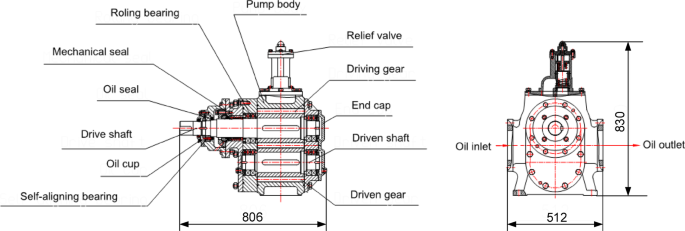
In summary, considering the specific application requirements and design parameters of gear pumps, the structure of the GNP2200 external gear high-viscosity pump is illustrated in Fig. 1. The pump dimensions are 806 mm × 512 mm × 830 mm (L × W × H). The main components include: pump housing, driving shaft, driving gear, driven shaft, driven gear, bearings, sealing assembly, oil cup, end cover, relief valve, and other accessories. The basic design parameters of high viscosity gear pump gears are shown in Table 1.

Structural configuration of the high-viscosity gear pump.
Experimental testing and statistical analysis
The hydraulic circuit diagram of the high-viscosity gear pump is shown in Fig. 2. When the motor is started, it drives the gear pump. The high-viscosity medium is pumped from the storage tank and passes through a pressure sensor and a flow meter. By adjusting the opening of the throttle valve, the pressure of the system circuit can be gradually increased. At each stable pressure point, data from all sensors are collected to evaluate the performance of the pump under different pressures. This circuit is designed to test the performance of the gear pump—primarily focusing on flow rate, volumetric efficiency, and input power—under varying outlet pressures, rotational speeds, and oil temperatures.

The hydraulic circuit diagram of the high-viscosity gear pump.
During the experiment, the medium temperature is first maintained at a specific value, and the drive motor speed is fixed. Then, by progressively adjusting the throttle valve in the circuit, different loads are applied to systematically increase the pump’s outlet pressure. At each stable pressure condition, the data acquisition system synchronously records readings from the pressure sensor, flow meter, speed/torque sensor, and temperature sensor—namely, the pump’s outlet pressure, actual output flow rate, input shaft speed and torque, and oil temperature. After real-time collection and storage, these raw data are used to calculate key pump performance indicators, including theoretical flow rate, volumetric efficiency, input power, and overall efficiency. Finally, performance curves of the pump under different pressures and temperatures are plotted.
Experimental tests were conducted on the high-viscosity gear pump under realistic operating conditions to measure the input shaft power under combinations of temperature (25–40 °C), pressure (1.0 MPa, 1.5 MPa, 2.0 MPa), pump speed (50, 100, 150, 200, 250, 300 r/min), and medium viscosity (150–1000 cP, 1000–3000 cP, 3000–5000 cP, 5000–8000 cP). The measured input power data were plotted using MATLAB, as shown in Fig. 3a–c.

Experimental data relationship between high viscosity gear pump speed and input shaft power under different pressures and medium viscosities.
The experimental values in Fig. 3a–c clearly indicate a positive correlation between pump speed and input power under the same delivery pressure. Higher viscosity of the transported medium also leads to greater input power. The discrepancies between the experimental data under various conditions and the enterprise requirements ranged from 3.2 to 4.7%. These observations are consistent with the calculated input shaft power from the design analysis of the GNP2200 high-viscosity gear pump. Although the computational results are slightly conservative, the error remains below 10% compared to the enterprise standard data. This margin of error meets the practical engineering requirements for aerospace composite production and demonstrates the operational reliability of the designed GNP2200 high-viscosity gear pump.
Performance analysis of high-viscosity pumps
The pumping capacity, as a primary performance parameter for pump evaluation, is fundamentally determined by rotational speed, volumetric efficiency, and energy efficiency in high-viscosity gear pumps16. Insufficient rotational speed leads to severe internal leakage, resulting in diminished volumetric efficiency. Conversely, excessive speed may cause medium expulsion from tooth spaces when inlet pressure is inadequate, creating cavities at the tooth base that increase suction resistance. This condition manifests as inadequate oil supply, cavitation, elevated vibration, and noise generation. Furthermore, high rotational speeds amplify axial/radial clearances and meshing gaps, while intense shear-induced heating from rapid operation causes dramatic temperature rises in high-viscosity media—collectively reducing pump efficiency and potentially compromising normal operation17. The operational efficiency of high-viscosity gear pumps directly governs their pumping capacity, with higher efficiency correlating to superior performance.
Pump rotational speed
High-viscosity gear pumps typically operate at relatively low speeds, primarily dictated by process requirements and material characteristics. The rotational speed for three operational phases can be estimated using the following empirical formulae18:
For media with kinematic viscosity ranging 1000–3000 mm2/s, the minimum pump speed is given by:
$$n = \frac{{8.1p \times 10^{10} }}{{v\left( {v + \sqrt {v + 0.01845} } \right)d_{a} }}\;\;\;({\text{r/mi}}n)$$
(8)
where V represent the minimum circumferential velocity of the high-viscosity gear pump, which can be derived from the above equation as:
$$V = \frac{{1.35\pi p \times 10^{9} }}{{v\left( {v + \sqrt {v + 0.01845} } \right)}}\;\;\;({\text{m/s}})$$
(9)
For media with kinematic viscosity ranging from 3000 to 8000 mm2/s, the minimum pump speed is given by:
$$n = \frac{{6.64p \times 10^{11} }}{{v\left( {v + \sqrt {v + 0.01845} } \right)d_{a} }}\;\;\;(r/\min )$$
(10)
Similarly, defining V as the minimum circumferential velocity of the high-viscosity gear pump, the equation transforms to:
$$V = \frac{{1.12\pi p \times 10^{10} }}{{v\left( {v + \sqrt {v + 0.01845} } \right)}}\;\;\;(m/s)$$
(11)
When handling media with kinematic viscosity between 0 and 5000 mm2/s, the maximum pump speed is determined by:
$$n = \frac{{8.5p \times 10^{4} }}{{0.0684 \times \left( {v + \sqrt {v^{2} + 0.01845} } \right)^{1/4} d_{a} }} + \frac{{9e^{ – v/20000} }}{{d_{a} \times 10^{ – 4} }}\;\;({\text{r/min}})$$
(12)
Similarly, defining V as the minimum circumferential velocity of the high-viscosity gear pump, the equation transforms to:
$$V = \frac{\pi }{60}\frac{{8.5p \times 10^{4} }}{{0.0684 \times \left( {v + \sqrt {v^{2} + 0.01845} } \right)^{1/4} }} + 9e^{ – v/20000} \times 10^{ – 4} \;\;({\text{m/s}})$$
(13)
where p denotes the outlet pressure (MPa); v represents the kinematic viscosity of the medium (mm2/s); da is the tip circle diameter (mm).
Pump volumetric efficiency
During operation of the high-viscosity gear pump, the volume of high-viscosity medium transported per revolution (V0) can be approximated as the difference between two cylindrical volumes based on gear kinematics19:
$$V_{0} = \frac{\pi }{4}\left( {d_{a}^{2} – d^{2} } \right)B = \;\frac{{\pi d_{a}^{2} B}}{4}\left[ {1 – \left( \frac{d}{d} \right)^{2} } \right]\;\;$$
(14)
where V0 is the displaced volume per revolution; dₐ is the tip circle diameter; d is the pitch circle diameter, B is the tooth width.
For external gear pumps with identical gears, the theoretical flow rate (Q0) under ideal leak-free conditions is:
$$Q_{0} = 2V_{0} n$$
(15)
where Q0 is the oretical flow rate; n is the rotational speed.
In practical operation, clearance between gears/pump housing and pressure differential (Δp) between inlet/outlet inevitably cause leakage (QL) and backflow, reducing actual flow rate20.
The relationship between leakage, pressure differential, and medium viscosity (ν) can be expressed as:
$$Q_{L} \propto \frac{{\Delta p^{1/\lambda } }}{v}$$
(16)
where λ is an exponential coefficient, empirically determined as λ = 0.35.
Since the high-viscosity media transported by high-viscosity gear pumps typically exhibit non-Newtonian fluid behavior, their rheological properties are significantly influenced by temperature, pressure, stress, and strain rate. The viscosity can be empirically modeled using the power-law equation21:
$$v = \gamma^{\lambda – 1} e^{ – bT}$$
(17)
where γ represents the shear rate, T denotes the temperature of the high-viscosity medium (K or °C), b is the temperature-viscosity coefficient, which is medium-dependent.
Assuming the shear rate is proportional to the gear’s rotational speed (γ ∝ n), then:
$$v \propto n^{\lambda – 1} e^{ – bT}$$
(18)
Combining Eqs. (16) and (18), the volumetric leakage flow rate (QL) of the pump can be derived as:
$$Q_{L} = K_{L} \left( {\frac{\Delta p}{{\Delta p^{0} }}} \right)^{1/\lambda } \left( {\frac{n}{{n^{0} }}} \right)^{1 – \lambda } e\left[ {b\left( {T – T^{0} } \right)} \right]$$
(19)
where KL is the leakage coefficient at \(n = n^{0}\), \(T = T^{0}\), (KL = 30.5 cm3/min); \(\Delta p^{0}\), \(n^{0}\), \(T^{0}\) represents the random comparative characteristic parameters.
Thus, the volumetric efficiency of the high-viscosity gear pump is expressed as:
$$\delta_{v} = \frac{{Q_{0} – Q_{L} }}{{Q_{0} }} \times 100\%$$
(20)
Energy efficiency analysis of the pump
The total power of the high-viscosity gear pump consists of the energy delivered to the medium and the energy dissipated due to internal friction during transport. Thus, the total power is given by:
$$P = P_{w} + P_{f}$$
(21)
$$P_{w} = \left( {Q_{D} – Q_{L} } \right)\Delta p$$
(22)
The frictional power loss can be expressed as:
$$P_{f} \propto \eta^{0} \gamma^{2}$$
(23)
Based on the power-law viscosity model,
$$v = \gamma^{\lambda – 1} e^{ – bT}$$
(24)
The frictional power loss can be expressed as:
$$P_{f} = K_{f} \frac{n}{{n^{0} }}e\left[ {b\left( {T^{0} – T} \right)} \right]$$
(25)
where Kf (Kf = 4.9 × 10⁻⁴ kW) is the power consumption coefficient of the gear pump at n = n0, T = T0. n0, T0, are the random comparative characteristic parameters (n = 1).
The energy efficiency (η) of the gear pump is then given by:
$$\delta_{E} = \frac{{P_{w} }}{P} \times 100\% = \frac{1}{{1 + P_{f} /P_{w} }} \times 100\%$$
(26)
Overall pump efficiency
The overall efficiency of the high-viscosity gear pump is determined by both its volumetric efficiency and energy efficiency, and can be expressed as:
$$\delta = \delta_{v} \times \delta_{E}$$
(27)
link