Study on the spatial mechanical behavior of the cable tower anchorage zone in long-span curved T-shaped rigid-frame extradosed bridge for high-speed railway
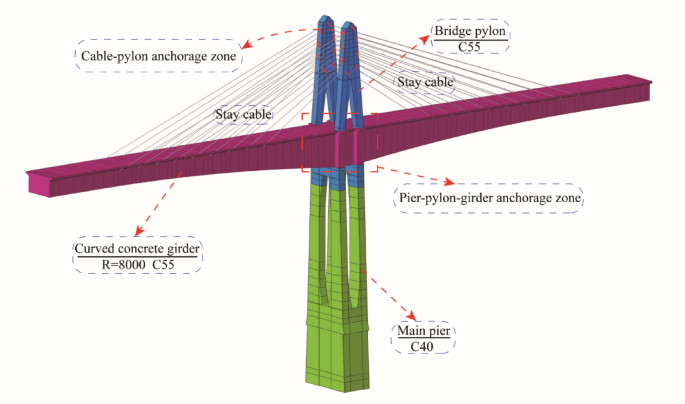
Spatial stress characteristics of the anchorage zone
To address the complex spatial stress state in the pylon anchorage zone of the extradosed cable-stayed bridge, a systematic stress analysis was conducted on three critical components: high-strength grout in tendon ducts, steel saddle structures, and pylon concrete. Given the repetitive configuration of saddle assemblies (Saddles #1–#7 sharing identical specifications, while #8–#9 featuring increased cable strands), five representative saddle pairs (#1, #4, #7, #8, and #9) were selected for detailed evaluation. Their principal stress states (σ₁ and σ₃), vertical normal stresses, and critical stress zones are summarized in Table 2, with corresponding stress contours illustrated in Figs. 5 and 6.

Vertical stress nephogram of high strength slurry of pipe (MPa).

Vertical stress nephogram of bridge tower and cable saddle steel shell (MPa). (a) The bridge tower, (b) Saddle steel shell.
Numerical simulations revealed that the grouted tendon ducts exhibited maximum principal tensile and compressive stresses of 5.04 MPa (Saddle #9) and − 7.91 MPa (Saddle #2), respectively, both below the material strength design thresholds (120 MPa). Vertical stress analysis identified peak compressive stress ( − 8.43 MPa) at the inter-duct wall of Layer 8 in Saddle #1, while maximum tensile stress (4.94 MPa) occurred at the duct wall of Layer 1 in Saddle #9.
The stress distribution characteristics demonstrated significant inhomogeneity due to the perforated cross-sections of grouted ducts. Vertical stress gradients exhibited progressive amplification toward the pylon apex, with compressive stresses accumulating downward along the saddle height due to load superposition effects. Notably, duct walls – identified as structural weak points – displayed pronounced stress concentrations. To elucidate vertical stress propagation patterns along both longitudinal (pylon axis, x = 0) and vertical directions, five critical paths (y1 ~ y5, see Fig. 2) across duct walls were analyzed for Saddles #1, #4, and #7, as depicted in Fig. 7.

Vertical stress distribution in high-strength grout. (a) 1# Strand-pipe of saddle, (b) 4# Strand-pipe of saddle, (c) 7# Strand-pipe of saddle.
Figure 7 reveals stratified vertical stress distributions along predefined paths within the grouted ducts, demonstrating position-dependent uniformity across curved segments. Adjacent paths (1–4) exhibited comparable vertical stress differentials with progressive escalation (e.g., stress increments of 1.32 MPa, 1.61 MPa, and 1.64 MPa between consecutive paths at Saddle #1). A notable stress mitigation occurred between Paths 4–5, attributed to reduced perforation density (− 0.41 MPa increment at Saddle #1 vs. 0.7 MPa at Saddle #7). These findings quantitatively confirm the critical influence of tendon duct configuration on stress evolution, suggesting optimized perforation design as an effective strategy for stress homogenization. Transitional stress discontinuities emerged at curve-to-linear segment interfaces, with path stresses converging to uniform values in linear regions before decaying linearly toward null states with increasing |x|. Linear segment stresses primarily originated from gravitational effects and layered cable force diffusion, maintaining minimal height-direction variation and enhanced uniformity within saddle zones.
Under operational loading, Saddle #7 exhibited tensile stresses ranging 1.7–0.2 MPa along Paths 1–2, induced by steel-grout interfacial bonding. Analytical results indicate that 74.3% of upper cable forces (Rows 1–3) were equilibrated through top-edge bonding constraints, while compressive dominance in Paths 3–5 confirmed force transfer to saddle sidewalls and basal concrete. The vertical stress distribution across multiple saddles further revealed a cumulative effect of cable forces from top to bottom: saddle #7 at the top exhibited tensile stress along path Y1 due to deformation compatibility under lower compressive confinement, whereas saddles at lower levels (e.g., #4 and #1) experienced a transition from tensile to compressive stresses, with near-zero stress occurring around saddle #4. This linear stress distribution explains the higher absolute stress value in saddle #7 compared to #4 and #1, as observed in Fig. 7c versus Fig. 7a and Fig. 7b. Comparative analysis also highlighted stress redistribution mechanisms: superposition of vertical cable components promoted steel–concrete deformation compatibility, with concrete-derived compressive forces neutralizing bond-induced tensile stresses. This explains the reduced tensile stress at Saddle #4 (0.35 MPa at Y1) versus Saddle #7 (1.8 MPa). As Table 2 indicates, persistent principal tensile stresses (up to 5.04 MPa) necessitate anti-cracking measures in grout design, particularly given their proximity to material strength thresholds.
Steel saddle analysis (Fig. 8a) identified peak von Mises stress (16.27 MPa) at Saddle #1’s web linear segment, well below the design strength (325 MPa) of Q355b steel, suggesting material optimization potential. Concrete evaluation (Fig. 8b and c) within the upper pylon (20.32 m below apex) showed principal tensile and compressive stresses of 1.77 MPa and − 5.09 MPa, respectively, both within C55 concrete elastic limits. Simultaneously, Fig. 8d demonstrates that the pylon is predominantly subjected to vertical compressive stresses, with maximum tensile and compressive stress components of 1.03 MPa and 5.59 MPa, respectively, along the vertical direction. Critical stress concentrations were observed at: Anchorage notches (compressive); Y-shaped bifurcations (tensile, 1.77 MPa vs. design strength 1.96 MPa). Notably, the 9.7% safety margin at bifurcations warrants reinforced detailing to mitigate cracking risks.

Stress distribution cloud diagram of concrete of rigid shell and bridge tower. (a) Von mises of steel shell structure, (b) Max principal of tower, (c) Min principal of tower, (d) Vertical normal stress of tower.
Figure 9 illustrates the longitudinal distribution of vertical compressive stress at the concrete-saddle interface, with saddle numbering consistent with Fig. 2. The vertical stress exhibits a characteristic “U”-shaped symmetric profile along the radial direction within the curved segments, accompanied by a uniform compressive stress distribution inside the arc zones. A noticeable reduction in compressive stress occurs at the transition between curved and straight segments, resulting in relatively lower stress levels within the straight portions. Further outward, localized stress intensification is observed due to the “L”-shaped obtuse-angle openings at the anchor notch, indicating mild stress concentration.

Stress distribution of concrete under saddle (MPa).
Under the action of cable forces decreasing progressively from saddle #9 (8950 kN) to #1 (6699 kN), the vertical compressive stress beneath the saddles accumulates gradually. Notably, the difference in vertical stress between adjacent saddles diminishes toward the lower region of the anchorage zone. This convergence behavior—particularly the nearly identical stresses under saddles 1 and 2—is attributed to the combined effect of reducing cable forces and increasing cross-sectional area of the pylon. When the decrease in cable force is insufficient to counteract the enhanced sectional stiffness, the stress distribution becomes uniform near the base. The stratified and parallel stress contours suggest significant superposition effects and confirm that the pylon remains within the elastic range under the applied loads.
Transverse distribution pattern of concrete stress beneath the saddle
The preceding analysis reveals that the concrete beneath cable saddles experiences a complex three-dimensional stress state with relatively high stress magnitudes, necessitating comprehensive investigation into its structural mechanical behavior. Previous studies20 have demonstrated that extradosed cable-stayed bridge saddles may develop splitting cracks propagating along tendon ducts under cable force actions. To systematically evaluate the transverse stress distribution patterns in saddle-underlying concrete and quantify potential splitting effects on pylon concrete, three representative saddles (#1, #5, and #9) were selected for targeted analysis. Figure 10 illustrates the transverse distribution of vertical stresses within a 1.2 m vertical range below these saddles, where x = 0 corresponds to the pylon’s longitudinal axis and y denotes the lateral distance from measurement points to the saddle base.

Transverse distribution of vertical stress in concrete under saddle. (a) 1# Strand-pipe of saddle, (b) 5# Strand-pipe of saddle, (c) 9# Strand-pipe of saddle, (d) Cloud diagram of 1# saddle, (e) Cloud diagram of 5# saddle, (f) Cloud diagram of 9# saddle.
Figure 10a–c reveal parabolic symmetrical stress distributions beneath the saddles, with intersecting stress contours at x = ± 400 mm for Saddles #5 and #9. Beyond x = ± 400 mm, these contours transition to stratified parallel patterns extending to ± 1150 mm. At Saddle #1 near the pylon’s Y-shaped bifurcation, maximum vertical compressive stress ( − 3.2 MPa) occurs at the saddle-concrete interface (y = 0.0 m). The 1.2 m analysis zone beneath Saddle #1 exhibits pronounced stress gradients (Δ σ(max) = 2.8 MPa) between x = − 400 mm and 400 mm, contrasting with the relatively uniform distributions observed at Saddles #5 and #9. As shown in Fig. 10d, stress redistribution toward the bifurcated limbs induces height-direction homogenization (variation coefficient < 8%) beneath Saddle #1, with subsequent stress increments primarily governed by self-weight superposition.
Due to the direct action of cable forces, the local compressive deformation of the saddle is greater than that of the surrounding tower concrete. Owing to the deformation compatibility of the concrete within the local region of the saddle, the compressive strain in the concrete around Saddle #1 to #8 is smaller than that on both sides. As a result, for Saddle #5 and #9, when y is approximately 1.2 m, the compressive stress within the range of x = − 400 to 400 mm is lower than that at the edges, as shown in Fig. 9e and f.
Meanwhile, when the compressive deformation of the concrete above the saddle is less than the local deformation of the saddle itself, tensile stress develops vertically in the upper part of the saddle. For instance, in Fig. 9c, a tensile stress of 0.43 MPa is observed above Saddle #9 at y = 1.0–1.2 m. Excessive deformation differences may cause the vertical tensile stress to exceed the bond stress between the saddle and the tower concrete, leading to potential debonding at the top plate of the steel shell box of the saddle and cracking of the concrete. The maximum vertical tensile stress, reaching 1.03 MPa, is located in the concrete above Saddle #9, as illustrated in Fig. 9f. Special attention should be paid to the stress state in this region during design and construction, and appropriate reinforcement measures should be considered.
Through understanding the lateral distribution pattern of the vertical compressive stress in the concrete beneath the saddle, in order to further explore the mechanical characteristics of the anchorage zone and reveal the impact of transverse splitting stress induced by vertical compressive stress on the concrete beneath the saddle, this paper will further analyze the distribution and effect of transverse splitting stress. In-depth analysis of the splitting stress distribution can provide theoretical support for structural design optimization, ensuring the safety and reliability of the structure under load.
Figure 11 shows the lateral distribution of splitting stress in the concrete beneath the saddle. From the stress cloud diagrams in Fig. 11d and e, it can be seen that the concrete mainly experiences tensile stress, which diffuses radially from the center towards both sides in a ring-like pattern, with an expansion angle of approximately 45°. The concrete splitting stress (lateral tensile stress) gradually increases within the range of 0–0.4 m from the bottom edge of the saddle and reaches its peak. The affected area is approximately a curved square shape, and after transmitting downward, it decreases gradually. The stress distribution shows a distinct layering effect, as shown in Fig. 11b and c. The maximum tensile stress occurs in the range of 0.2–0.6 m beneath the 1# saddle of the strand tube, approximately 0.11 MPa, which is far below the allowable tensile stress of the concrete. The affected area is relatively small, and the concrete’s crack resistance in the anchorage zone meets the requirements.

Transverse distribution of concrete splitting stress beneath the saddle. (a) 1# Strand-pipe of saddle, (b) 5# Strand-pipe of saddle, (c) 9# Strand-pipe of saddle, (d) Cloud diagram of 1# saddle, (e) Cloud diagram of 5# saddle, (f) Cloud diagram of 9# saddle.
Due to the vertical spacing of the saddles being 1.2 m, the stresses in the strand tubes corresponding to h = 1.2 m in Saddles 5# and 9# are exactly the same as the lateral stresses at the contact interface between the top plate of the steel shell of Saddles 4# and 8# and the concrete of the tower, as shown in Fig. 11b and e. Affected by the load from the lower strands, the concrete stress curves in Saddle 5# from h = 0.8 m to 1.2 m show an “M”-shaped distribution, while the upper part of Saddle 4# in the range of h = 0.4 m displays lateral compression, and after extending to both sides, it transforms into a tensile state. The stress curve at h = 0 m is exactly the opposite, exhibiting a “W”-shaped distribution. It is important to note that while these specific stress distributions are complex, the mechanical resistance of the anchorage zone is primarily governed by inherent structural properties, such as the concrete grade and reinforcement ratio. As indicated by the numerical results, the maximum lateral tensile stress induced by these patterns is 0.13 MPa (Fig. 11), which is significantly lower than the design tensile strength of the C55 concrete (1.96 MPa). Therefore, the structural capacity of the anchorage zone is more than adequate. Due to the combined lateral and vertical forces acting on the sidewall concrete from the saddle, a lateral compressive stress region is formed at a 45° downward angle on the sidewall. From h = 0–0.4 m, and in the symmetric region x = 400–1150 mm, the concrete experiences compressive stress while also inducing lateral tensile stress at the top of the saddle. Therefore, during design, it is advisable to consider increasing reinforcement in the tensile region to prevent concrete cracking.
Spatial force transfer mechanism in the anchorage zone
Unlike traditional parallel-guided strand tube saddles, the anchorage zone of this bridge tower primarily consists of the high-strength grout, the steel shell structure, and the surrounding concrete on the saddle. The cable force directly acts on the side of the strand tubes, diffusing the load through the high-strength grout in the saddles, and then transferring it to the four contact surfaces of the saddle through the box-shaped steel shell structure. Due to the superimposed effects of the load, the load transfer ratio for each strand tube saddle differs, and the equivalent load of the cable force is directed toward the center of the arc segment of the saddle. The load transfer paths on different segments of the same saddle and the load distribution on its four surfaces will exhibit significant differences.
The structure of the anchorage zone mainly bears vertical compressive stress under the action of the cable force. The previous analysis shows that the vertical stress distribution in the saddle’s arc segment is uniform, so the primary analysis focuses on the vertical load distribution on the four plates of the box-shaped steel shell along the centerline of the bridge tower, as shown in Fig. 2. Based on the finite element calculation results, the stress along the vertical direction of the selected cross-sections of each plate is integrated, and the internal force ratio of each plate is calculated. This allows for a quantitative analysis of the load transfer mechanism between the components of the saddle in the anchorage zone. The load-bearing ratio coefficient is calculated using Eq. (12).
$$\alpha =\frac{t{\int }_{0}^{l}s\left(l\right)dl}{\sum t{\int }_{0}^{l}s\left(l\right)dl}\times 100\left(\%\right)$$
(12)
where t represents the thickness of each plate, l represents the length of the end section of each plate, s represents the stress along the vertical direction at the nodes of the end section of each plate.
For the vertical force, it manifests as shear stress on the two web plates, while it acts as surface pressure on the top and bottom plates. The load distribution ratios for 1# to 9# saddle seats are shown in Table 3, with the finite element calculation diagrams and the sectional area percentage curves illustrated in Fig. 13. During the bridge erection process, the saddle is positioned and installed using a rigid framework, as shown in Fig. 12.

For the local structure of the anchor zone of the cable-stayed tower, the load transfer path is as follows: stay cable to high-strength grout in the strand tube to steel shell to bridge tower concrete. As shown in Table 3 and Fig. 13, the load from the stay cables at 1# to 7# saddle seats is primarily transmitted through the web plates of the box-type steel shell to the concrete of the bridge tower after passing through the high-strength grout. The load transfer between the two web plates is almost identical, with each web plate carrying approximately 40% of the load. The load distribution on the bottom plate increases slightly, reaching about 20%, for the 1# to 7# saddle seats, due to the cumulative load effect. The top plate mainly bears the compressive stress transferred by the upper concrete, so the load transfer from the grout to the top plate is negligible, at 0%, for the 1# to 7# strand tube saddles.

Stress distribution ratio on the cable saddle surface. (a) Finite element schematic diagram (MPa), (b) Load distribution ratio.
For the 8# to 9# saddle seats, the load distribution ratio on the web plates decreases sharply, particularly in the 9# strand tube area, where the load distribution is only 6%. The load on the bottom plate increases to 53%. Due to the smaller distance from the tower top and the absence of external load effects above, the local deformation of the 9# saddle seat anchor zone is much greater than that of the concrete above the saddle, inducing vertical tensile stress in the concrete above the saddle. Consequently, the load carried by the top plate increases to 34%. When the tensile stress exceeds the bond strength between the top plate and the concrete, the steel plate at the top of the 9# strand tube saddle may detach from the concrete structure, which could affect the durability of the steel shell. This situation should be carefully considered in the design analysis.
Additionally, in the cross-section of the strand tube, due to the superposition effect of the cable forces, the compressive strain gradually increases. However, the relative deformation at the top is much greater than at the bottom. To ensure coordinated deformation between the grout and the steel shell, while the load is transmitted downward through the lower layers, it also acts on the web plates of the shell. Since the stiffness of the shell is significantly greater than that of the grout, based on the principle of stiffness distribution during load transfer, the web plates primarily bear the load, as shown in Fig. 14a. For the 8# to 9# strand tubes, the load is first distributed to the top plate to satisfy the coordinated deformation of the top of the saddle. Since the relative deformation on both sides is relatively small, the load distribution on the web plates significantly decreases, as shown in Fig. 14b.

Strain cloud diagram of filament hole. (a) 1# saddle, (b) 9# saddle.
Parameter sensitivity analysis
The reasonable selection of parameters plays a significant role in structural optimization design and improving engineering safety21. Previous studies have shown that the radius of the circular arc section has a significant impact on the stress distribution in the anchor zone. Furthermore, as demonstrated by the theoretical calculations in Sect. 2.2, the load distribution is related to both the cable force and the radius of the circular arc section. To investigate the effects of cable force and the radius of the cable saddle’s circular arc section on the stress in the anchor zone, and to optimize the saddle design, a parameter analysis of the cable force and the radius of the circular arc section is conducted. This analysis provides a basis for on-site construction control.
To study the influence of the variation ratio of cable force λ (the ratio of the increase in cable force to the original cable force) and the curvature radius r of the cable saddle’s circular arc segment on the spatial stress state in the bridge tower anchor zone, while keeping other parameters constant, λ is varied from 0 to 20% in 2% increments, and r is varied from 4.5 to 5.5 m in 0.1 m increments. The variation in the spatial stress in the key cross-sections of the concrete in the bridge tower anchor zone is examined. The results for the tensile stress in the high-strength grout, vertical stress in the concrete below the 1# strand saddle, and maximum principal tensile stress in the bridge tower are shown in Figs. 15, 16 and 17.

Variation law of principal tensile stress in high-strength grout with respect to various parameters. (a) Curvature of the cable saddle arc segment, (b) The variation ratio of cable force.

Variation law of concrete vertical stress under saddle with respect to various parameters. (a) Curvature of the cable saddle arc segment, (b) the variation ratio of cable force.

Variation law of maximum principal tensile stress of bridge tower with respect to various parameters. (a) Curvature of the cable saddle arc segment, (b) the variation ratio of cable force.
As shown in Fig. 15, the principal tensile stress in the high-strength grout for each strand tube varies similarly with the radius r of the cable saddle’s circular arc segment. The tensile stress decreases gradually as the radius increases, and the absolute value of the stress increment is generally larger at r = 4.5 m compared to r = 5.5 m, where the rate of change slows down. Among these, the deviation in the rate of change for the 9# cable saddle is the most noticeable. At r = 4 m, the rate of change is 22.6%, while at r = 5 m, it is − 6%. Since the load concentration q is linearly related to the cable force, the maximum principal stress in the high-strength grout of 1# saddle increases linearly with the increase in cable force increment ratio λ. This behavior can be explained by the fundamental mechanical relationship between the cable-grout interaction and structural design principles. The radial pressure transmitted from the stay cable to the grout is inversely proportional to the saddle arc radius r and directly proportional to the cable force parameter λ. In compliance with the Chinese railway design code, which mandates the use of the allowable stress method, the structure is required to behave linearly under all design load conditions. As a result, stress variations induced by load fluctuations can be accurately described using the principle of linear elasticity. It is this underlying mechanism that accounts for the characteristic decrease in principal tensile stress with increasing r and its linear increase with λ.
As seen in Fig. 16, the vertical stress in the concrete beneath the 1# saddle decreases with the increase in r Under constant cable force, increasing r reduces the load concentration on the contact surface. At the same time, the length of the circular arc segment increases, and the vertical stress in the concrete beneath the saddle also decreases. The curves in the figure exhibit a relatively uniform layering distribution. In contrast, the vertical stress distribution in the linear section of the saddle is different. When r ≤ 5.1 m, there is a noticeable stress concentration at the ends of the linear section, which significantly impacts local stress. As λ increases, the vertical stress beneath the 1# saddle shows a layered distribution with a clearly linear pattern.
As shown in Fig. 17, the principal tensile stress in the bridge tower is less affected by changes in the curvature of the cable saddle, but is more significantly influenced by changes in cable force. It generally varies linearly, with the maximum principal tensile stress located at the bifurcation point. According to linear calculations, when λ = 70%, the principal tensile stress at the bifurcation point reaches the allowable concrete stress value of 2.97 MPa, providing approximately 1.7 times the safety margin for the bridge tower structure.
The parameter analysis indicates that as the radius r of the arc segment decreases, the length of the curved section also reduces. According to the equivalent load calculation theory for the strand tube in Sect. 2.2, the load on the contact surface increases, which can lead to stress concentration, resulting in a significant rise in the principal tensile stress of the high-strength grout in the strand tube. At the same time, as the curved section shortens, stress diffusion is constrained, and the length of the linear section increases. Since the linear section does not directly bear the cable force, and the vertical distance between the saddles remains unchanged, this leads to an increased influence of the upper saddle on the stress in the lower saddle. Consequently, the vertical stress in the concrete beneath the saddle increases, exacerbating transverse cracking and raising the risk of concrete failure.
When the radius r of the arc segment falls within the 5–5.5 m range, the stress state of the saddle anchorage zone is more balanced. After considering the effects of the increased radius on the friction coefficient of the hole wall and the shortening of the linear section, it is recommended that the radius r of the saddle’s arc segment be set within the 5–5.5 m range during the design phase. Additionally, both the principal tensile stress of the high-strength grout in the strand tube and the vertical stress in the concrete beneath the 1# saddle exhibit a linear increase as the cable force increment ratio λ rises. Within a 20% cable force increment range, the structure operates in an elastic state. Linear analysis further confirms that the bridge tower structure maintains a significant safety margin, offering valuable guidance for cable force control during construction.
Based on theoretical analysis and its implementation in engineering practice, the Changtu River Bridge has been successfully constructed. The Fig. 18 presents actual engineering photographs captured during the bridge erection process.

The site construction of Changtu river bridge.
link