Modular unit design and energy consumption characterization analysis of a novel cantilever robot
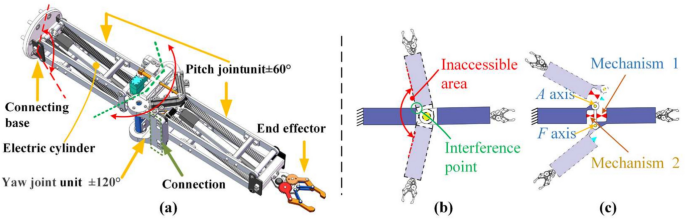
The object of this part of the analysis is the 3-DOF combination type shown in Fig. 1. During the analysis, only the characteristics of the analyzed module are considered, while the remaining modules remain in their initial state. The influence of friction is not considered in the analysis process.
Analysis of motion characteristics of the yaw joint module unit
To establish the drive relationship of the yaw module, the right deflection is taken as an example for illustration (the principle of left deflection is the same, so it will not be repeated here). As shown in Fig. 5a, this is a simplified motion diagram of the offset rotary guide mechanism, in which the dimensions of each component are known, namely the crank L1, the offset distance L2, and the fixed rod lengths L3 and L4. Assuming that the prime mover crank rotates counterclockwise at a constant angular velocity \(\dot{\theta_1 }\) = 1 rad/s, this paper uses an analytical method to solve for the angular displacement \(\theta_1\), angular velocity \(\dot{\theta_2 }\), and angular acceleration \(\ddot{\theta_2 }\) of the guide rod G.

Motion analysis of the yaw module unit. (a) Simplified Diagram of Right Deflection Motion of the Yaw Module. (b) Angular displacement curve of \(\theta_{2}\). (c) Angular velocity \(\dot{\theta }_{2}\) and angular acceleration \(\ddot{\theta }_{2}\) curves. (d) Angular displacement curve of \(\theta_{0}\). (e) Angular velocity \(\dot{\theta }_{0}\) and angular acceleration \(\ddot{\theta }_{0}\) curves.
By establishing the closed vector polygon of the mechanism, the displacement equation of the offset guide mechanism can be obtained and written in the form of complex vectors, as shown in Eq. (1).
$$\left\{ {\begin{array}{*{20}l} {L_{1} = L_{4} + L_{3} + L_{2} + S_{I} } \hfill \\ {L_{1} e^{{i\theta_{1} }} = L_{4} e^{i0} + L_{3} e^{i(\pi /2)} + L_{2} e^{{i\theta_{2} }} + S_{I} e^{{i\left( {\theta_{2} + \pi /4} \right)}} } \hfill \\ \end{array} } \right.$$
(1)
After applying Euler’s formula \(e^{i\theta } = \cos \theta + i\sin \theta\) to Eq. (1) and separating the real and imaginary parts, we obtain Eq. (2) through reorganization. Equation (2) gives a system of equations with two unknowns, where SI represents the displacement of the slider in the direction of guide rod G, and θ2 represents the angular displacement of guide rod G. By solving the equation, the relationship between θ2 and θ1 can be obtained. Taking the derivative of both sides of Eq. (2) with respect to time t and rearranging, the relationships between the angular velocity \(\dot{\theta_2 }\) and angular acceleration \(\ddot{\theta_2 }\) of member L1 and guide rod G with respect to \(\theta_{1}\) can be derived.
$$\left\{ {\begin{array}{*{20}l} {L_{1} \cos \left( {\theta_{1} } \right) = L_{4} + L_{2} \cos \left( {\theta_{2} } \right) + S_{I} \cos \left( {\theta_{2} + \pi /4} \right)} \hfill \\ {L_{1} \sin \left( {\theta_{1} } \right) = L_{3} + L_{2} \sin \left( {\theta_{2} } \right) + S_{I} \sin \left( {\theta_{2} + \pi /4} \right)} \hfill \\ \end{array} } \right.$$
(2)
In Fig. 5b, the starting and ending positions of θ2 are consistent on the circumference, indicating that the representation of angles is periodic. The starting point at − 64.5° and the ending point at 295.5° represent the same position. This form of expression is used to demonstrate the continuity of angular displacement. Under the condition that the yaw module unit is designed to deflect within the range of ± 120°, taking right deflection as an example (the principle of left deflection is the same and will not be repeated here), the range of θ3 is 0–120°. Through geometric calculations, the range of θ2 is found to be − 30° to 90°. Observations of the three sets of curves in Fig. 5b,c indicate that the mechanism operates relatively smoothly, meeting the requirements of transmission.
Analysis of the motion characteristics of the pitch joint module unit
The driving mechanism of the pitch structure is realized by changing the length of the diagonal of the parallelogram. After establishing the relationship from Fig. 4a, the relationship between the diagonal length e and the pitch joint angle \(\theta_{0}\) is obtained, as shown in Eq. (3).
$$\theta_{0} = \arcsin \left( {\left( {a^{2} + b^{2} { – }e^{2} } \right)/2ab} \right);\quad e \in [194,287]$$
(3)
Calculate the angular velocity and angular acceleration of the electric cylinder at a constant speed of \(\dot{e}\) = 10 mm/s using Eq. (3) It is known that under the condition of a pitch module unit designed with a deflection angle of ± 60°, the length range of the electric cylinder is from 194 to 287 mm, as shown in Figs. 5d,e. The mechanism operates smoothly and meets the transmission requirements of the pitch module unit.
Analysis of force characteristics and energy consumption characteristics of pitch joint module unit
As shown in Fig. 6a, when the support end of the pitch module unit mechanism is in the vertical position, for a strictly diagonally driven parallelogram mechanism, the output force Fe of the driving element, the electric cylinder, is primarily related to the magnitude of the load force FL generated by the gravity M in the vertical direction, and is independent of the distance L1 from the load to the joint body. Due to the structural specificity of the pitch module unit, when the end load is influenced by the force arm L1, a local torque TL is generated. When all joints are in a static state, the mechanical equilibrium relationship of the system can be described by the following set of equations, as shown in Eq. (4).
$$T_{L} = F_{L} L_{1} ;\quad T_{F} = F_{3} L + F_{4} L;\quad T_{L} = T_{F}$$
(4)
where F3 and F4 represent the force components along the direction of the linkage. Theoretically, under the premise that the linkage is considered as a rigid body and all joints are in a static state, changing the distance from the end load to the center of rotation will only affect the forces F1 and F2 along the direction of the rod, but will not affect the output Fe of the driving element, the electric cylinder. However, the force components of the load gravity in non-vertical states may affect performance. This paper only considers the vertical state.

Motion analysis of the pitch module unit. (a) Force diagram of the pitch module unit connecting rod. (b) Force analysis of the pitch module after installing the spring. (c) A schematic diagram of the force acting on the pitch module unit 1. (d) Relationship Diagram of Electric Cylinder Force Fe, Spring Stiffness Coefficient k, and Pre-Stretch Length Lk. (e) Comparative Diagram of Electric Cylinder Force Fe Versus Spring Stiffness Coefficient k for Three Sets of Different Pre-Stretch Lengths Lk. (f) Shows the relationship between the cylinder force Fe and different spring stiffness coefficients k when the pre-stretch length Lk is 15.
Based on the mechanical analysis of Fig. 6a, considering the vertical downward direction of the end load force FL, we derive the relationship expression between the driving force Fe of the electric cylinder and the load FL generated by the robot joint’s own weight M as a function of the pitch angle θ0, as shown in Eq. (5).
$$Fe = \frac{{F_{L} }}{a}\sqrt {a^{2} + b^{2} – 2ab\,\sin (\theta_{0} )} ;\quad \theta_{0} \in \left[ { – 60^{\circ } ,60^{\circ } } \right]$$
(5)
As shown in Fig. 6b, the load FL acts vertically downwards, and the electric cylinder is installed along the BD diagonal, serving as a tension rod. The compression rod is subject to instability and buckling issues, which actually enhance its stability during operation. Upon analyzing Eq. (5), it is found that the tensile force Fe exerted by the electric cylinder during the pitching process is 3–5 times that of the load force FL, indicating that the load force FL generated by the robot’s own weight has a significant impact as the pitching angle changes. To optimize system performance and reduce energy consumption, a tensile spring component is introduced into the pitch joint module unit and installed in parallel with the electric cylinder to form a Parallel Elastic Actuator (PEA). The core feature of the PEA is that the required force or torque for the controlled object is provided jointly by the driving element and the elastic unit19,20,21. As shown in Fig. 6b,c, the electric cylinder and the tensile spring are installed in parallel along diagonal e of BD. The tensile force generated by the spring, denoted as Fs, acts in the same direction as Fe and together they resist the load force FL, as described by Eq. (6). In this equation, k represents the spring’s elastic coefficient, e1 is the initial length of the electric cylinder (i.e., the shortest length of diagonal BD in posture 1 shown in Fig. 6c), and Lk is the preload length of the spring (i.e., the length to which the spring is already stretched when installed). By varying the preload length Lk of the spring, different preload forces can be provided, which can offset part of the load force experienced by Fe at the initial position.
$$\left\{ {\begin{array}{*{20}l} {F{\text{e}} + Fs = \frac{{F_{L} }}{a}\sqrt {a^{2} + b^{2} { – }2a{\text{b}}\,\sin (\theta_{0} )} } \hfill \\ {Fs = k\left( {\sqrt {a^{2} + b^{2} – 2ab\,\sin (\theta_{0} )} – e_{1} + L_{k} } \right)} \hfill \\ \end{array} } \right.\quad \theta_{0} \in \left[ { – 60^{\circ } ,\,60^{\circ } } \right]$$
(6)
Based on Fig. 6c, the principle by which the spring reduces system energy consumption is as follows. In an ideal scenario where friction is neglected, the pitch module unit 1 exhibits two states of the spring during its operation. Firstly, there is the energy storage region. As the pitch module unit transitions from posture 1 to posture 2, the spring is stretched by a length of \(\Delta e\) (i.e., the change in diagonal length), thereby storing elastic potential energy. The work done by the spring force Fs is denoted as Es, the work done by the electric cylinder force Fe is Ee, and the work done by the load force FL (which is the gravitational potential energy generated by the weight of the robotic arm itself) is EL. It is known that when the pitch module unit is moving at a constant speed or is in a static state (with the electric cylinder self-locking in the static state), the equation ES + Ee = EL holds true, It is expanded as shown in Eq. (7). Without the spring installed, ES would be zero, and the gravitational potential energy EL generated by the load force would have to be entirely balanced by Ee. To maintain the normal pitch speed, the electric cylinder would need to increase its output torque to counteract the load, thereby consuming energy. With the introduction of the spring, part of EL is converted and stored as elastic potential energy ES through the stretching of the spring, reducing the magnitude of Ee. Secondly, there is the energy release region. As the pitch module unit transitions from posture 2 to posture 1, the spring contracts and releases energy. At this point, the spring component is in the energy release phase, converting the stored elastic potential energy Es back into gravitational potential energy EL.
$$\left\{ {\begin{array}{*{20}l} {E_{S} = \frac{1}{2}k(\Delta e + L_{{\text{k}}} )^{2} ; \, \quad Ee = Fe(\Delta e);\quad E_{L} = F_{L} h} \hfill \\ {\frac{1}{2}k\left( {\sqrt {a^{2} + b^{2} + 2ab\sin (\theta_{0} )} – e_{1} + L_{{\text{k}}} } \right)^{2} + Fe\left( {\sqrt {a^{2} + b^{2} + 2ab\sin (\theta_{0} )} – e_{1} } \right) = F_{L} h} \hfill \\ \end{array} } \right.$$
(7)
By rationally utilizing the energy storage and release characteristics of springs, the energy management of the system is optimized, thereby enhancing the motion performance and energy efficiency of the pitch joint module.
During the pitching process, the magnitude of the spring force Fs is influenced by the spring’s stiffness coefficient k and the preload length Lk. Calculating appropriate values for k and Lk can optimize the torque balancing effect of Fs, as described by Eq. (8). Five different stiffness coefficients (k = 0, 1, 2, 3, 4) are considered. Due to the stretching limit of the tension spring, the maximum preload length Lk during installation is only 15 mm. Lk ranges from 0 to 15 mm, and the magnitude of Fe is shown in Fig. 6d. For clearer analysis, three sets of curves are generated with Lk = 0, 7.5, and 15 mm, as illustrated in Fig. 6e. Taking k = 4 N/mm as an example, when the pitch angle θ0 is 0 degrees, the pusher force Fe gradually decreases with increasing Lk. However, this observation should not be limited to this single point. The optimal preload length Lk and stiffness coefficient k can be calculated by determining whether the area enclosed by the single Fe curve and the horizontal axis representing the pitch angle is minimized.
By rationally utilizing the energy storage and release characteristics of springs, the energy management of the system is optimized, thereby enhancing the motion performance and energy efficiency of the pitch joint module. During the pitching process, the magnitude of the spring force Fs is influenced by the spring’s stiffness coefficient k and the preload length Lk. Calculating appropriate values for k and Lk can optimize the torque balancing effect of Fs, as described by Eq. (8). Five different stiffness coefficients (k = 0, 1, 2, 3, 4) are considered. Due to the stretching limit of the tension spring, the maximum preload length Lk during installation is only 15 mm. Lk ranges from 0 to 15 mm, and the magnitude of Fe is shown in Fig. 6d. For clearer analysis, three sets of curves are generated with Lk = 0, 7.5, and 15 mm, as illustrated in Fig. 6e. Taking k = 4N/mm as an example, when the pitch angle θ0 is 0 degrees, the pusher force Fe gradually decreases with increasing Lk. However, this observation should not be limited to this single point. The optimal preload length Lk and stiffness coefficient k can be calculated by determining whether the area enclosed by the single Fe curve and the horizontal axis representing the pitch angle is minimized.
$$\left\{ {\begin{array}{*{20}l} {Fe = \left( {\frac{{F_{L} }}{a} – k} \right)\sqrt {a^{2} + b^{2} – 2ab\,\sin (\theta_{0} )} + k(e_{1} – L_{k} )} \hfill \\ {Optimalk\, \, L_{k} = \arg \frac{\min }{{L_{k} ,k}}\left( {\int_{{ – 60^{ \circ } }}^{{ – 60^{ \circ } }} {\left| {Fe\left( {L_{k} ,k,\theta_{0} } \right)} \right|d\theta_{0} } } \right)} \hfill \\ \end{array} } \right.$$
(8)
where Fe is a function that depends on Lk, k, and θ0. By iterating through all possible combinations of Lk and k, we find the set of parameters that yield the minimum integral value. Through calculation, the optimal solution for Lk is found to be 15 mm, and for k, it is 2 N/mm, with the minimum integral value being 4423. However, the magnitude of this integral value does not represent any specific performance metric. Given the relationship between the pitch angle and the change in length e of the electric actuator, the energy consumption Ee of the pitch unit under different spring stiffness coefficients can be obtained by integrating the actuator force Fe with respect to the actuator length \(e = \sqrt {a^{2} + b^{2} – 2ab\, sin\left( {\theta_{0} } \right)}\). The results are shown in Table 1.
$$E = \int {\left| {F_{e} } \right|} de$$
(9)
Calculations show that when k = 2 N/mm, the energy consumed by the pitch module during a single upward movement reaches its minimum of 3.29 J. Compared to the scenario without a spring installed, i.e., when k = 0, the energy savings percentage is approximately (13.21 J − 3.29 J)/13.21 J = 75.1%.
link